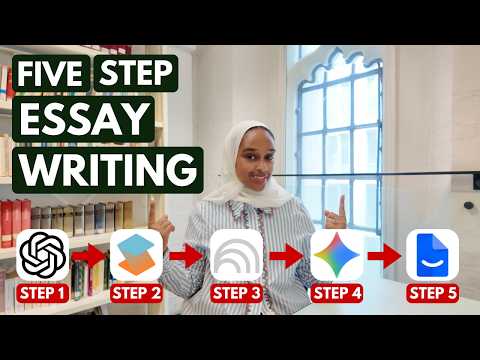
00:00In this 10-minute tutorial, you are going to learn how to write a literature review using AI without plagiarizing, ethically, and only using true sources
00:09So, let's start with step number one
00:10For this step, you need to scope your topic and find keywords
00:12And for this, we're going to use Gemini or even ChatGPT; both work
00:17First, before you find papers, you need to have a clear question and the right language to actually search with
00:22So, this is where finding keywords is really important
00:25I think a lot of people skip this step because they just think, "I have the question, I have the topic, I'll just type that topic in." And when you do that, you miss out on critical research papers because you don't actually know what the..
00:37Keywords are that you're looking for, what the non-negotiable keywords are, what the keywords are that don't really matter, the dependent variables, the independent variables
00:46All of these things are really important to determine from the beginning
00:47So, you can use this prompt in Gemini
00:49I'm interested in the impact of remote work on employee well-being
00:54What are the key sub-themes or debates in this academic field? Help me to narrow this down to a specific research question for a literature review
01:01Once you've really refined what that question is, you can then go ahead and prompt again and say, "What are the main keywords I need to be using to search for literature?" And by the time you finish doing this, which..
01:15It shouldn't take you too long, half an hour at most
01:16You'll have a really well-defined research question, and you'll also have a set of keywords that you can use in the next step, where you actually go ahead and find literature
01:27The second step is searching, discovering, and analyzing research papers
01:30So now you have your keywords and now you know the research question and exactly what you're looking for
01:34You can go on to SciWord
01:36Now, SciWord is a really good one because you can actually type in your research question in the question box or in the search box, and it gives you a full set of research papers in columns that include the abstract, the summary, the methods used, the results, the limitations, the..
01:54[Music] Gap, opportunity
01:56Like, it's really good at providing you with that information from just one research question or just a few keywords
02:03Sci-Space is very good at finding highly relevant papers, and you can also filter by a date, type of paper
02:11So, for example, systematic reviews only, primary research papers only, or review papers only, and you can really pick that out
02:18Then you can go ahead and analyze the papers
02:22You can open each paper individually and ask questions like: What are the key results from this paper? What are the main takeaways? What is the gap in this paper? What are some limitations? What is the main thing to understand from this paper? Or, if you don't..
02:33[Music] Something
02:44Can you explain result number two in more detail? By doing this, you've identified the top 10 research papers that you are going to use in your literature review, and you've also analyzed them and started to understand the topics that will make up your full literature review
02:55Using ScienceBase for this is really good because it rapidly finds papers, helps you analyze them with the help of the co-pilot, and then you kind of have a good list that you can just save in your favorites to start going into more depth right away
03:13The next thing we're going to do, so step three, is synthesizing your information, and for this, we're going to be using Notebook LM
03:22Notebook LM I feel like is a bit of an underdog
03:24Like not many people know about it, and many students don't use it
03:28And I feel like it's actually one of the best tools out there that's also completely free, and it really shines in this step when it comes to writing a literature review
03:36It acts as your personal research paper that's grounded only in the information that you provide
03:42So, you can provide research papers, PDFs, documents, videos, audio—whatever you provide, it will then base the information off of that
03:50So, to do this, you want to: number one, create a new notebook and then upload your sources
03:56So, all the 10 PDF papers that you collected in step two, you want to upload them
04:00Then you want to chat with your sources
04:02This allows you to ask questions across all of your uploaded documents simultaneously, so you can do things like find themes
04:08[music] You can compare and contrast, identify gaps, also map theories as well
04:15It really synthesizes the understanding of the topic
04:17By the end of this, you'll have the core themes, you'll have all the debates, you'll know the gaps in your literature, and you'll be really confident in what you're going to include — maybe what's even missing from what you already have — and you'll also get an outline and an understanding of how you're going to write this literature review
04:34I think one thing that I've noticed with students is that when they come to write, they just start writing very..
04:38Quickly
04:41They find some papers, read them very quickly, and then just start writing
04:44When actually, if you're able to do steps one, two, and three, when you begin to write, you've done the hard work—the difficult part where you're synthesizing, understanding, and organizing—that's all done
04:56And that's the part that's actually quite challenging when you're writing your literature review
05:01So, if you can have already completed that using tools like Notebook LM, you're in a good place to just begin writing and insert information where necessary
05:09Step four is structuring and drafting a bit of an outline or a plan
05:15And again, for this, you can either use Gemini or ChatGPT or even do it yourself if you don't
05:19Want to use AI tools
05:20So, what you can do is go to your notebook and say, "Based on our conversation, generate a thematic outline for my literature review." For each theme, list the key authors and their main points
05:32Then, from that thematic review, you can ask Gemini to give you a strong outline [music] that you can begin writing from
05:44Remember, this is the critical part where students can do things that are not allowed, such as plagiarizing
05:49You don't want to copy and paste anything
05:52Even when it comes to outlines, you don't want to just write in the given outline
05:58You need to make sure that it makes sense, that it flows, and that it includes what you want to include
06:03If they give you any text or information, Don't just copy and paste it
06:07This is where things get a little bit murky, so I'd definitely like to give a big warning to be really careful with how you're writing and that you're not copying and pasting anything at any point by any AI tool, no matter what they say and no matter how original they might claim it is
06:24So, now that you have your outline, your research papers, and a good understanding, step five is writing
06:30For this, you want to use Paperpal, and I think Paperpal is one of the best out there when it comes to academic writing, as it is based on the fact that you're writing
06:38It is quite an ethical tool, I would say, as a tool in general, not a tool that is doing the writing for you or finishing the writing off for you
06:46You are starting to write or for you
06:48It's a tool that says, "You have your text, let me help you polish it." You have your text, let me give you feedback
06:55You have some text, let's do a bit more research
06:56But it's really focusing on the fact that you have written your own text
07:00And I think that's really important with Paper Pal
07:02You can fix your grammar, you can fix your punctuation
07:05A really cool thing as well about Paper Pal is that it's academically focused
07:08So the suggested keywords, the synonyms—anything that suggests are based on academic use, not just general use
07:15That's really important again as a student
07:18So by the end of it, you'll have a really good, polished text that you're ready to be proud of and to submit
07:22And if you'd..
07:27Like a human to read it, I do have a company called The Page Doctor, where we only have PhD students or graduates read through academic work written by students
07:32We don't use AI
07:34That's one of the big things
07:36We do not use AI in any of our feedback, editing, or anything
07:39It's only human-based feedback and proofreading
07:45Otherwise, you can just go and do it yourself with AI
07:46The idea is that a real human reads it, giving you feedback that will hopefully help you improve your text and your writing, while avoiding plagiarism or crossing any ethical lines
07:58I'll leave a link for it down below, so feel free to click and try us out
08:01If you enjoyed this video, leave me a thumbs up, and don't forget to..
08:05Let me know if this was helpful
08:07I hope that you have a good literature review writing experience
08:09It really isn't as scary as it sounds, and I have lots of other content related to literature review writing as well
08:17So, if you'd like to check that out, you can just search for "literature review" on my channel
08:19I also have a couple of other videos, too
08:21And yeah, I hope to see you in my next one.

 本教學影片將說明如何運用 AI 工具,以合乎學術倫理且避免抄襲的方式,完成文獻回顧的五個步驟。