LilysAI
WebEstensione ChromeApp AndroidApp iOS
Video e audio
Riassunto YouTubeRiassunto podcastTrascrizione YouTubeRiassunto documentariRiassunto audioAudio in testo
Documenti
Riassunto PDFChatPDFRiassunto paperRiassunto Doc
Centro assistenzaNote di aggiornamento
Prezzi
English한국어日本語Español中文العربيةDeutschFrançaisBahasa IndonesiaItalianoPortuguêsTiếng Việt
Inizia
Inizia
WebEstensione ChromeApp AndroidApp iOS
Riassunto YouTubeRiassunto podcastTrascrizione YouTubeRiassunto documentariRiassunto audioAudio in testoRiassunto PDFChatPDFRiassunto paperRiassunto Doc
Centro assistenzaNote di aggiornamento
Prezzi
English한국어日本語Español中文العربيةDeutschFrançaisBahasa IndonesiaItalianoPortuguêsTiếng Việt
Vedi il video originale nel visualizzatore IA
Greg Isenberg
Greg IsenbergViews 28,7628/7/2025
Script
Script

00:00Sam Altman says that there's going to be a one-person solopreneur billion-dollar company over the next few years

00:05Now, ever since I heard him say this, it's been stuck in my head

00:09Is it actually possible? Can you have one person come up with a billion-dollar company? I mean, it's the dream, but is it possible? Um, today's episode is about completely unpacking that, uh, figuring out, is it worth it? How you can structure your company so that you can create a billion-dollar outcome? How, how do you can create AI agents to actually go and do that? Is this actually possible? Um, and it's just my, my thinking about you

00:21You know, this whole thing

00:34If I was going to start a billion-dollar solopreneur business, how would I structure my business today? And I'm going to explain everything from top to bottom

00:46So, this is a completely free episode

00:49People charge thousands of dollars for this

00:53This is free, um, because I hope it inspires one of you to go and start something, hopefully a billion-dollar solo business

01:02[Music] The quote that Sam Altman says is, "We're going to see one-person companies with billion-dollar valuations pretty soon." In my little group chat with my tech CEO friends, there's this betting pool for the first Year, there was a one-person billion-dollar company, which would have been unimaginable without AI, and now it will happen

01:27Um, that quote used to sound insane

01:31Uh, today it sounds like it's possible

01:33It sounds like it could be next quarter, and I'm going to explain why

01:36Um, when you think about an AI-first company versus a traditional company, and now we're creating AI-first companies, you basically have a founder that manages a bunch of agents that do tasks

01:49Um, now even in Sam Altman's statement, he mentions that we're going to see 10-person companies with billion-dollar valuations pretty soon

01:57Uh, he Doesn't say, he doesn't say this, but I think we're going to see that sooner, and then we're going to see the one-person billion-dollar company

02:04And the reason why he's saying that is because, you know, some of these will could become people, like you might not want to hire, create a creator agent

02:13You might want to hire hire a creator, or you might want to hire a person that manages some of these agents

02:20And by the way, if you stick around to the end of this video, I'm going to be an episode, I'm going to be sharing exactly how I would structure a company

02:27But yeah, AI first company

02:30Um, and then a

02:32Traditional company is just people managing people

02:35So you have an executive team, VP sales manages, uh, the sales team, the VP marketing, uh, manages the marketing team, the VP engineering manages the engineering team

02:45So this is like a mindset, uh, shift when you're, you're starting your business

02:51Um, and Sam Altman actually says himself, he says the future of startups could just be one person and 10,000 GPUs

02:55So what he means by that is, you know, there's a lot of compute that is going to be powering the outcomes of these agents

03:06Now, the old way of building a company, a startup, is you would come up with an idea

03:11You'd write it on a napkin, then you'd go and fundraise

03:13Maybe that's friends and family, maybe that's venture capital

03:17You'd hire people, you'd build the product, you'd launch the product

03:21Hopefully it worked, hopefully people bought it, and then you'd scale it, and that's what you would do

03:25And it would, and it would take time, and it was also, you know, not everyone had, you know, wealthy friends to hire, uh, to raise money from, and not everyone lived in San Francisco

03:36So the new path is a bit different, and I haven't seen anyone, uh, you know, summarize this new path in this way, so let me know if this

03:45resonates with you all

03:47So the first thing you do is you start with an audience

03:49So, you actually go and start a Twitter account, an Instagram, a Tik Tok, and then you vibe code, uh, something for that audience

03:54You launch it

03:59Um, and then you build more of a community than an audience

04:04So, over time, as you're building an audience, you're trying to build this community, a private community or, you know, IRL events, just hardcore people who love your brand and what you're doing

04:16And then you build, you know, you use AI agents for automating a lot of the work, and then you go and repeat

04:22So this is the old path

04:24This is the new path

04:26I'm going to give you an example of, uh, of how you can do the new path

04:28Um, and I'm going to use myself as an example just because, um, you know, it's, it's the easiest example to give

04:36I'm just talking about myself here

04:40So, uh, before I started, you know, a lot of you all know ideabrowser.com, which is, I give this, you know, free startup idea of the day, um, on this platform, but a lot of people don't know that it started off by me just tweeting startup ideas

04:53So if you think about my account, I just tweet about startup ideas

04:57People started, I noticed that people liked them

04:59So I built a, you know, I vibecoded, uh, using

05:05Cursor, mostly, uh, this product called ideabouser.com

05:09I also built a community for it called Startup Empire, which is a private community, and now I've gone and automated a lot of this here

05:15Now, there is humans in the loop

05:17The Idea Browser team is three people, including myself, so it's not a one-person billion-dollar company, but it just goes to show you that if you have an idea for something, just start a X account or an Instagram account, and then from there, you can learn about what people like, learn about the different formats that work

05:37You know, it took me a while to get to this format, and then you

05:38Can, you know, build that community and start automating it over time

05:42Sam Altman, the co-founder of OpenAI, just said that it is the era of the idea guy, and he is not wrong

05:51I think that right now is an incredible time to be building a startup, and if you listen to this podcast, chances are you think so, too

05:59Now, I think that you can look at trends to basically figure out what are the startup ideas you should be building

06:06So, that's exactly why I built ideaser.com

06:08Every single day you're going to get a free startup idea in your inbox, and it's all backed by high quality data trends

06:17How we do it? People always ask

06:20We use AI agents to go and search what are people looking for, and what are they screaming for in terms of products that you should be building, and then we hand it on a, you know, silver platter for you to go check out

06:34Um, we do have a few paid plans that, you know, take it to the next level, uh, give you more ideas, give you more AI agents, and more almost like a chat GBT for ideas with it, but you can start for free ideabrows.com, and if you're listening to this, I highly recommend it

06:50So that's the new path

06:53Um, I think another interesting thing about this era that we're in is, um, and I just want to, I want to

07:01Mention this every uh new era that we've been in, 1990s with the computer revolution, 2000's cloud revolution, mobile and SAS revolution in the 2010s brought it more leverage

07:13So what what's happened is, um, it's just been quicker to launch things and you can get to bigger outcomes, uh, through, uh, with the smaller teams

07:23So, um, that's just something to know about this era that we're in

07:27Um, and I, you know, we should also talk about like why this is happening, like why is it actually possible for you to go and start a business that could, could potentially be a billion dollars

07:37Um, and I narrowed it down to these

07:40Five mega trends

07:42So one is that, uh, you know, for the first time ever, services are becoming software

07:47It used to be software as a service, SAS

07:49Um, but now, uh, with AI agents actually having the ability to fulfill, uh, the service

07:57So let's say instead of hiring a social media manager, you're hiring an AI agent that does the social media managing

08:03Instead of hiring a copywriter, you're hiring a, a, a copywriter AI agent that goes and fulfills it

08:11And that's the business, right? You, the person listening to this, are going to, could go and actually go and create that as an AI agent and then charge hundreds of

08:19Dollars or tens of dollars a month for it

08:21So this has completely unlocked a whole new set of, um, of, uh, of businesses

08:28Second is that there's instant distribution, so you can go and, you know, start an X account or an Instagram, build followings, or if you don't want to do that, and that's not your style, you can also just partner with existing creators and get instant distribution

08:45Um, we're also, you know, this era we're in, we're built on top of the shoulders of giants, so you can go and integrate with Open AI, you can go and start a Shopify, these tools exist

08:56You can go and use Supabase, you can go and use Netlify

09:01You

09:06You can go and use all these different tools, um, and of course, you have to pay to use these tools, but you know, you're accessing billions of dollars of R&D, uh, with a flick of a button

09:10I also think that there's this new trust in small brands

09:13You know, there's this new trend, you know, shop local, right? Like it's almost like people want indie hackers and indie startups to win

09:21I think that's a big reason why Peter Levels and people like him, people are, you know, they want to buy his products and services because they feel like, uh, you know, I'd rather buy it from him than buy it from Mark Zuckerberg or whoever

09:28And

09:34Then the last thing is that there's these high precision ad platforms for the first time ever

09:41Um, and it's not just Meta, it's, you know, Google, it's TikTok

09:47Um, you know, X is starting to get quite good at it

09:50Um, so, you know, you could, with the right offer, you can access people and they'll buy your service, and then you, as you know, the person who wants to go and create a billion dollar one-person business, uh, your core skills are going to be code leverage, audience leverage, and capital leverage

10:07So I think it was Naval who talked about this

10:11Um, so, you know, you want, you know, you can, there's only three ways in in

10:17This world where you can get leverage, in this world you can get leverage is through code, and through audience, and through capital

10:21So you, you know, you are trying to refine these things as much as possible

10:25Of course, you, you might not be the best developer, but you need, you want to understand it, and you want to, you know, surround yourself with the right, um, you know, products and agents that go and help create, uh, the best code

10:36You, you know, you might want to get really good at audience building and thinking about what sort of formats are working, etc., etc

10:45And then capital, as you know, is something that you build up

10:47Over time, so you might be thinking, okay great, I kind of buy that there might be this opportunity to build a billion dollar one-person business, but how do I actually get started? And you know, if I were just getting started, this is, this is what I would do

11:03I would start as a freelancer in something, so I would be like, maybe I'm a visual designer, I'm a, I'm a, I'm a product designer

11:11I, I design apps, mobile apps, let's say, and then I, uh, I create a productized service around it, and I say, you know, for $5,000, I will design your, your mobile app, five screens or less

11:24And then you get an idea for a micro-SaaS, and I did a

11:27Whole EPO, uh, I did a whole episode around Microsass and how to start one

11:31I can link it in the description if you're interested in that, but it's basically this idea

11:36What is the one feature that you can create that you can sell to people, um, that's a software, um, and then you have AI agents fulfill the actual outcome, and that's the, uh, that's the way that, you know, you progress through your soloreneur journey, and while you're doing it, uh, you're building an audience, so you, you're thinking about how I could, you know, you know what niche you want to be, what micro niche you want to be, and you're getting better at it

12:03You're getting more followers, uh, every single day, you're committing to actually posting, and that could be, you know, you could have AI agents help you in that, but you're committing to the game of building an audience

12:15And, you know, I put this over here

12:17I saw this, uh, really good, you know, 100 proven hooks

12:19I think, uh, the Twitter account it came from is a guy named Marada, and he just like summarized like the hundred just hooks that work like POV, you just found the, the app that replaced your therapist, or this is why your screen time is actually 11 hours, or your parents don't know about this money hack

12:36So, You know, while you're getting really good at your fulfillment, you have to get really good at your audience development, too

12:44Like, you, this, you have to live and breathe this, and I think that's a big part of what will make a successful $1 billion uh business

12:52So, if you want to think about your org chart a little bit, like this is potentially what it could be

12:57So, you're over here, you're the solo founder, and then you have these LLMs that basically manage these agents

13:03So you have engineering agents, which is code generation, testing, QA, DevOps, deploying

13:11You have design agents, UIUX creation, brand assets

13:13You have marketing agents, which are content creation, SEO, SEM, social media

13:17You have sales agents, which are lead qualifications, outreach, demo booking

13:25You have support agents, which is ticket triage, documentation, and then you'll have data analyst agents

13:29So, it's this whole idea around you're creating this hierarchy and you're going to have a bunch of agents fulfill it

13:35And like I said in the beginning, you might have people do some of this, uh, in the beginning, like UIUX, you might outsource to a person

13:44Um, you might outsource this to a small design agency

13:47Um, but over time, The idea is to basically have this all fulfilled by super intelligence

13:56Um, so that way you can go be on your beach and, you know, things are just working and you don't have to deal with people

14:08Um, and then the way this works, like actually tangibly, like you can think of, like, real, here's like real time agent activity, right? So imagine you have on your team, you have a researcher, a creator, an analyst, an operator, and strategist

14:20So basically, uh, the researcher is feeding data, the creator is generating content, the analyst is processing metrics, the operator is handling tasks, the strategist is

14:28Making decisions that goes into a central database, and you basically have this productivity gain that you gain from having these uh agents work for you 24/7

14:40And this is what Sam was basically talking about

14:42I think, you know, I can't, I can't read his mind, but I think that he he's thinking about like there is this world where you're going to have agents fulfilling these these these tasks

14:55Now, when I was thinking about this, I was like, there's obviously a world where this goes, you know, horribly wrong

15:01And, you know, I wanted to just make mention that this is this is how it could go wrong, right? So, like, you can create something, and then you over-automate something, and it loses the human touch, and then your business goes down

15:15Like, you know, it might cap out at 100k or 300k or something, and then it'll just, just not work, right? So, um, you know, you could have bad documentation, your agents could produce garbage, you can have bad quality control, and then you, you know, you have mistakes

15:33You don't have a customer contact, and then you lose connection

15:37But I think that, you know, the person that's going to end up creating this billion-dollar one-person company is just going to, like, all these things are

15:42Going to be extremely dialed

15:46All the rules are going to be, uh, dialed

15:51All the references are going to be completely dialed

15:52The output of all this is going to be as good, if not better, than a human being

15:57And as the models get better over time, um, that'll be easier

16:03So now you have to put a lot more work into actually feeding context, continuously giving these rules, but I think over time they'll just get better, just like human beings

16:12You know, if you have a smart person on your team, um, let's say in social media, even if they, you know, they join and they only have one year of experience, but after Year two and three, and they see what works, and the metrics are being fed into them, and they understand feedback loops, and they're hard working, and their goals, you know, they've got goals, then, uh, over time, you know, some of my best employees have been younger people who've just learned really quickly

16:36So, I think that's, uh, that's just something to call out

16:44The other thing I wanted to call out, I saw this tweet, uh, today that, uh, is this guy named Mark Lou? He's so solopreneur, and he says, "How long did it take my little SAS to grow? Uh, 1K MRR, 2K MRR, 3, 4." So, 1K took four months, 2K took three months, 3K took two

17:00Months, and 4K took one month." And this guy has like an audience of like hundreds of thousands or hundred

17:08Yeah, I think it's hundreds of thousands

17:09So, it takes time and it's not easy

17:12I, I don't want to sugarcoat it

17:14Like, it's not easy

17:16It takes time

17:18So, I do think that whoever is going to come up with this billion dollar, you know, one-person thing, um, it might look something like this

17:24Like the curve might be slow and then, you know, suddenly all at once

17:29I put together a 2x2 matrix, uh, to just show how, like, where the opportunity is to create agents that do work for people that you can charge money for

17:42Um, so on the Y-axis you have the value, so like obviously you want as much value as possible, and on the X-axis is you want, is you want repetition

17:51You want as much repetition as possible

17:53So, if you're selling social media management as an agent, you want the customer that you're selling to, to want to do that multiple times a day, because if it's high repetition and it's high value, then that's where the gold mine is

18:08So, this is where, you know, you want to, this is kind of the sweet spot

18:12You want to be here

18:14Um, and you obviously don't want to be here

18:17You don't want to have something that's low value and not

18:20really repetitive because then it'll be hard to sell

18:22You're coming up with ideas for things

18:24Think about, think about it like that

18:25And then, by the way, from, I saw this uh episode, I thought it was a good episode around, um, on Lenny's podcast, uh, around choosing the right AI pricing archetype

18:37I also think that there's, you know, thinking about how to actually price your AI agent business on one person business

18:44Um, you know, is it going to be usage-based pricing? So what does that mean? Pay for what you consume

18:51Is it going to be outcome based pricing? You know, the win-win model, so per outcome

18:54So, for For example, uh, Finn, I think, is like an app from Intercom, and I'm pretty sure that it's a customer support agent that, you know, you implement on your website, and if it works, like if there's a resolution that happens with a customer, you get charged some amount of money

19:17Um, seat-based, which is Slack, Figma, Grammarly, I think this is going to be less and less common

19:23Um, I think the more interesting ones are going to be something like usage-based and outcome-based, like there's an opportunity to, if you're building your one-person billion-dollar company, to think to do something more like usage-based and

19:36Outcome based, because this is a new type of model that you can, you know, that, uh, you know, you could have done it before without AI, but it's, it's way easier to do now, or you can think about a hybrid pricing model, so the base fee and consumption

19:48So as you're thinking about pricing, this is the way to think about it

19:52I tend to think that the usage based pricing and outcome based pricing is the most, uh, fastest way to, to a billion

20:01There's two more things I want to cover

20:02Um, not every business can be built like a one person billion dollar founder business, so let's talk about the ones that can and the ones that can't

20:10So if it's a digital product, yes, it can

20:12If it's not a digital product, then you're going to need human labor, so obviously it's not going to be a one-person business

20:20Uh, if it's B2B SAS or a consumer app, like a mobile app, um, yes, it could, it could be a billion-dollar business, but if it's a complex B2B, uh, app or B2B SAS, um, you're going to need a sales team

20:35Um, so you, you probably don't want to do that

20:38Um, and when I'm talking about that, I'm talking about like a healthcare company, you know, a defense company, education, uh, you know, selling into the Fortune 500, you do need sales teams

20:54Um, can AI handle the Core value? Um, you know, if there's some, we're at the stage right now that that might not be possible for everything

21:03So thinking about, uh, the one, you know, the business that you're going to start, think about the ones that it's actually possible today

21:10For example, social media management

21:12You can actually get it done, that it researches, uh, it manages it, and it's able to create the content in a pretty good way that it adds value

21:20So if not, you're going to need human specialists, and then you can't be a one-person business

21:24Uh, regulatory requirements

21:27Um, if there's heavy, uh, regulatory

21:29requirements, you're going to need compliance

21:31I'm talking fintech

21:34I'm talking healthcare

21:36Um, but if there's light or none, you're, you're Gucci

21:39And then, uh, network effects

21:42You're going to want to start a one-person business with network effects

21:46If you don't think that it's possible that there's network effects, it's going to be possible, but I think it's going to just be extremely hard

21:51Um, if you do have network effects in some capacity, I think it'll be a lot easier

21:59To conclude, is the $1 billion solo founder possible? Here's, here's where I netted out on it

22:02Technically, yes

22:06Um, AI Provides the leverage

22:09So, if you have the right product, the right marketing, the right timing, the right person, um, the first solo unicorn is probably coming in 2026 to 2028

22:18I think the 10 person 1 billion dollar company is probably coming, uh, you know, sooner than that

22:26Um, well, two, you know, it's probably being built right now, uh, but, you know, so yes, it's possible

22:34Practically though, it does require these perfect conditions, and I think that in the future, as AI keeps improving, um, it'll just be easier to actually do this

22:46Um, so I think it's totally possible

22:50I think right now it's quite extremely

22:52Extremely, extremely rare, um, but the fact that it's even possible, uh, is absolutely cool, um, and it fires me up

23:08I mean, you know, this has never been possible in history that you've been able to, um, go and actually, uh, potentially start a one-person business that is worth $1 billion

23:19So for all of you listening who made it to the end, uh, let me know if this, you know, these little education episodes are interesting to you, like this one or the microsass episode

23:31Um, my goal is to teach you, um, about a particular topic that I'm thinking about in real time, and, um, I can't wait to see the either one-person billion-dollar company

23:43That you create, or the 10 billion dollar company you create

23:47Um, I'll keep sharing these videos and episodes for free so that you can enjoy them, create something cool, and if you need a startup idea, you know where to find them: Ideabrowser.com, or continue listening to this podcast, um, the startup ideas podcast

24:02And I will see you in the, uh, YouTube comments

24:04I read every single one

24:09Um, and please let me know what you would like me to cover, uh, next

24:13Um, Micros was the first one in this educational style

24:16This time it's the one-person billion-dollar company

24:20What would you like next? Um, because I want to

24:22Cover the things that you care about and that you're trying to learn, uh, as fast as possible

24:26Happy building, and have a creative day.
EsploraUnicorno Unipersonale 20251103

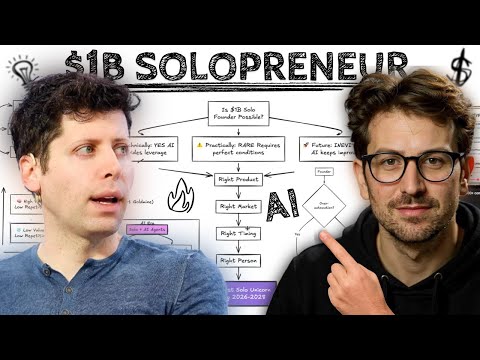
Guadagnare $$$ con la tesi sul solopreneurship di Sam Altman e GPT5

Vedi il video originale nel visualizzatore IA
Greg Isenberg
Greg IsenbergViews 28,7628/7/2025
Script
Script

00:00Sam Altman says that there's going to be a one-person solopreneur billion-dollar company over the next few years

00:05Now, ever since I heard him say this, it's been stuck in my head

00:09Is it actually possible? Can you have one person come up with a billion-dollar company? I mean, it's the dream, but is it possible? Um, today's episode is about completely unpacking that, uh, figuring out, is it worth it? How you can structure your company so that you can create a billion-dollar outcome? How, how do you can create AI agents to actually go and do that? Is this actually possible? Um, and it's just my, my thinking about you

00:21You know, this whole thing

00:34If I was going to start a billion-dollar solopreneur business, how would I structure my business today? And I'm going to explain everything from top to bottom

00:46So, this is a completely free episode

00:49People charge thousands of dollars for this

00:53This is free, um, because I hope it inspires one of you to go and start something, hopefully a billion-dollar solo business

01:02[Music] The quote that Sam Altman says is, "We're going to see one-person companies with billion-dollar valuations pretty soon." In my little group chat with my tech CEO friends, there's this betting pool for the first Year, there was a one-person billion-dollar company, which would have been unimaginable without AI, and now it will happen

01:27Um, that quote used to sound insane

01:31Uh, today it sounds like it's possible

01:33It sounds like it could be next quarter, and I'm going to explain why

01:36Um, when you think about an AI-first company versus a traditional company, and now we're creating AI-first companies, you basically have a founder that manages a bunch of agents that do tasks

01:49Um, now even in Sam Altman's statement, he mentions that we're going to see 10-person companies with billion-dollar valuations pretty soon

01:57Uh, he Doesn't say, he doesn't say this, but I think we're going to see that sooner, and then we're going to see the one-person billion-dollar company

02:04And the reason why he's saying that is because, you know, some of these will could become people, like you might not want to hire, create a creator agent

02:13You might want to hire hire a creator, or you might want to hire a person that manages some of these agents

02:20And by the way, if you stick around to the end of this video, I'm going to be an episode, I'm going to be sharing exactly how I would structure a company

02:27But yeah, AI first company

02:30Um, and then a

02:32Traditional company is just people managing people

02:35So you have an executive team, VP sales manages, uh, the sales team, the VP marketing, uh, manages the marketing team, the VP engineering manages the engineering team

02:45So this is like a mindset, uh, shift when you're, you're starting your business

02:51Um, and Sam Altman actually says himself, he says the future of startups could just be one person and 10,000 GPUs

02:55So what he means by that is, you know, there's a lot of compute that is going to be powering the outcomes of these agents

03:06Now, the old way of building a company, a startup, is you would come up with an idea

03:11You'd write it on a napkin, then you'd go and fundraise

03:13Maybe that's friends and family, maybe that's venture capital

03:17You'd hire people, you'd build the product, you'd launch the product

03:21Hopefully it worked, hopefully people bought it, and then you'd scale it, and that's what you would do

03:25And it would, and it would take time, and it was also, you know, not everyone had, you know, wealthy friends to hire, uh, to raise money from, and not everyone lived in San Francisco

03:36So the new path is a bit different, and I haven't seen anyone, uh, you know, summarize this new path in this way, so let me know if this

03:45resonates with you all

03:47So the first thing you do is you start with an audience

03:49So, you actually go and start a Twitter account, an Instagram, a Tik Tok, and then you vibe code, uh, something for that audience

03:54You launch it

03:59Um, and then you build more of a community than an audience

04:04So, over time, as you're building an audience, you're trying to build this community, a private community or, you know, IRL events, just hardcore people who love your brand and what you're doing

04:16And then you build, you know, you use AI agents for automating a lot of the work, and then you go and repeat

04:22So this is the old path

04:24This is the new path

04:26I'm going to give you an example of, uh, of how you can do the new path

04:28Um, and I'm going to use myself as an example just because, um, you know, it's, it's the easiest example to give

04:36I'm just talking about myself here

04:40So, uh, before I started, you know, a lot of you all know ideabrowser.com, which is, I give this, you know, free startup idea of the day, um, on this platform, but a lot of people don't know that it started off by me just tweeting startup ideas

04:53So if you think about my account, I just tweet about startup ideas

04:57People started, I noticed that people liked them

04:59So I built a, you know, I vibecoded, uh, using

05:05Cursor, mostly, uh, this product called ideabouser.com

05:09I also built a community for it called Startup Empire, which is a private community, and now I've gone and automated a lot of this here

05:15Now, there is humans in the loop

05:17The Idea Browser team is three people, including myself, so it's not a one-person billion-dollar company, but it just goes to show you that if you have an idea for something, just start a X account or an Instagram account, and then from there, you can learn about what people like, learn about the different formats that work

05:37You know, it took me a while to get to this format, and then you

05:38Can, you know, build that community and start automating it over time

05:42Sam Altman, the co-founder of OpenAI, just said that it is the era of the idea guy, and he is not wrong

05:51I think that right now is an incredible time to be building a startup, and if you listen to this podcast, chances are you think so, too

05:59Now, I think that you can look at trends to basically figure out what are the startup ideas you should be building

06:06So, that's exactly why I built ideaser.com

06:08Every single day you're going to get a free startup idea in your inbox, and it's all backed by high quality data trends

06:17How we do it? People always ask

06:20We use AI agents to go and search what are people looking for, and what are they screaming for in terms of products that you should be building, and then we hand it on a, you know, silver platter for you to go check out

06:34Um, we do have a few paid plans that, you know, take it to the next level, uh, give you more ideas, give you more AI agents, and more almost like a chat GBT for ideas with it, but you can start for free ideabrows.com, and if you're listening to this, I highly recommend it

06:50So that's the new path

06:53Um, I think another interesting thing about this era that we're in is, um, and I just want to, I want to

07:01Mention this every uh new era that we've been in, 1990s with the computer revolution, 2000's cloud revolution, mobile and SAS revolution in the 2010s brought it more leverage

07:13So what what's happened is, um, it's just been quicker to launch things and you can get to bigger outcomes, uh, through, uh, with the smaller teams

07:23So, um, that's just something to know about this era that we're in

07:27Um, and I, you know, we should also talk about like why this is happening, like why is it actually possible for you to go and start a business that could, could potentially be a billion dollars

07:37Um, and I narrowed it down to these

07:40Five mega trends

07:42So one is that, uh, you know, for the first time ever, services are becoming software

07:47It used to be software as a service, SAS

07:49Um, but now, uh, with AI agents actually having the ability to fulfill, uh, the service

07:57So let's say instead of hiring a social media manager, you're hiring an AI agent that does the social media managing

08:03Instead of hiring a copywriter, you're hiring a, a, a copywriter AI agent that goes and fulfills it

08:11And that's the business, right? You, the person listening to this, are going to, could go and actually go and create that as an AI agent and then charge hundreds of

08:19Dollars or tens of dollars a month for it

08:21So this has completely unlocked a whole new set of, um, of, uh, of businesses

08:28Second is that there's instant distribution, so you can go and, you know, start an X account or an Instagram, build followings, or if you don't want to do that, and that's not your style, you can also just partner with existing creators and get instant distribution

08:45Um, we're also, you know, this era we're in, we're built on top of the shoulders of giants, so you can go and integrate with Open AI, you can go and start a Shopify, these tools exist

08:56You can go and use Supabase, you can go and use Netlify

09:01You

09:06You can go and use all these different tools, um, and of course, you have to pay to use these tools, but you know, you're accessing billions of dollars of R&D, uh, with a flick of a button

09:10I also think that there's this new trust in small brands

09:13You know, there's this new trend, you know, shop local, right? Like it's almost like people want indie hackers and indie startups to win

09:21I think that's a big reason why Peter Levels and people like him, people are, you know, they want to buy his products and services because they feel like, uh, you know, I'd rather buy it from him than buy it from Mark Zuckerberg or whoever

09:28And

09:34Then the last thing is that there's these high precision ad platforms for the first time ever

09:41Um, and it's not just Meta, it's, you know, Google, it's TikTok

09:47Um, you know, X is starting to get quite good at it

09:50Um, so, you know, you could, with the right offer, you can access people and they'll buy your service, and then you, as you know, the person who wants to go and create a billion dollar one-person business, uh, your core skills are going to be code leverage, audience leverage, and capital leverage

10:07So I think it was Naval who talked about this

10:11Um, so, you know, you want, you know, you can, there's only three ways in in

10:17This world where you can get leverage, in this world you can get leverage is through code, and through audience, and through capital

10:21So you, you know, you are trying to refine these things as much as possible

10:25Of course, you, you might not be the best developer, but you need, you want to understand it, and you want to, you know, surround yourself with the right, um, you know, products and agents that go and help create, uh, the best code

10:36You, you know, you might want to get really good at audience building and thinking about what sort of formats are working, etc., etc

10:45And then capital, as you know, is something that you build up

10:47Over time, so you might be thinking, okay great, I kind of buy that there might be this opportunity to build a billion dollar one-person business, but how do I actually get started? And you know, if I were just getting started, this is, this is what I would do

11:03I would start as a freelancer in something, so I would be like, maybe I'm a visual designer, I'm a, I'm a, I'm a product designer

11:11I, I design apps, mobile apps, let's say, and then I, uh, I create a productized service around it, and I say, you know, for $5,000, I will design your, your mobile app, five screens or less

11:24And then you get an idea for a micro-SaaS, and I did a

11:27Whole EPO, uh, I did a whole episode around Microsass and how to start one

11:31I can link it in the description if you're interested in that, but it's basically this idea

11:36What is the one feature that you can create that you can sell to people, um, that's a software, um, and then you have AI agents fulfill the actual outcome, and that's the, uh, that's the way that, you know, you progress through your soloreneur journey, and while you're doing it, uh, you're building an audience, so you, you're thinking about how I could, you know, you know what niche you want to be, what micro niche you want to be, and you're getting better at it

12:03You're getting more followers, uh, every single day, you're committing to actually posting, and that could be, you know, you could have AI agents help you in that, but you're committing to the game of building an audience

12:15And, you know, I put this over here

12:17I saw this, uh, really good, you know, 100 proven hooks

12:19I think, uh, the Twitter account it came from is a guy named Marada, and he just like summarized like the hundred just hooks that work like POV, you just found the, the app that replaced your therapist, or this is why your screen time is actually 11 hours, or your parents don't know about this money hack

12:36So, You know, while you're getting really good at your fulfillment, you have to get really good at your audience development, too

12:44Like, you, this, you have to live and breathe this, and I think that's a big part of what will make a successful $1 billion uh business

12:52So, if you want to think about your org chart a little bit, like this is potentially what it could be

12:57So, you're over here, you're the solo founder, and then you have these LLMs that basically manage these agents

13:03So you have engineering agents, which is code generation, testing, QA, DevOps, deploying

13:11You have design agents, UIUX creation, brand assets

13:13You have marketing agents, which are content creation, SEO, SEM, social media

13:17You have sales agents, which are lead qualifications, outreach, demo booking

13:25You have support agents, which is ticket triage, documentation, and then you'll have data analyst agents

13:29So, it's this whole idea around you're creating this hierarchy and you're going to have a bunch of agents fulfill it

13:35And like I said in the beginning, you might have people do some of this, uh, in the beginning, like UIUX, you might outsource to a person

13:44Um, you might outsource this to a small design agency

13:47Um, but over time, The idea is to basically have this all fulfilled by super intelligence

13:56Um, so that way you can go be on your beach and, you know, things are just working and you don't have to deal with people

14:08Um, and then the way this works, like actually tangibly, like you can think of, like, real, here's like real time agent activity, right? So imagine you have on your team, you have a researcher, a creator, an analyst, an operator, and strategist

14:20So basically, uh, the researcher is feeding data, the creator is generating content, the analyst is processing metrics, the operator is handling tasks, the strategist is

14:28Making decisions that goes into a central database, and you basically have this productivity gain that you gain from having these uh agents work for you 24/7

14:40And this is what Sam was basically talking about

14:42I think, you know, I can't, I can't read his mind, but I think that he he's thinking about like there is this world where you're going to have agents fulfilling these these these tasks

14:55Now, when I was thinking about this, I was like, there's obviously a world where this goes, you know, horribly wrong

15:01And, you know, I wanted to just make mention that this is this is how it could go wrong, right? So, like, you can create something, and then you over-automate something, and it loses the human touch, and then your business goes down

15:15Like, you know, it might cap out at 100k or 300k or something, and then it'll just, just not work, right? So, um, you know, you could have bad documentation, your agents could produce garbage, you can have bad quality control, and then you, you know, you have mistakes

15:33You don't have a customer contact, and then you lose connection

15:37But I think that, you know, the person that's going to end up creating this billion-dollar one-person company is just going to, like, all these things are

15:42Going to be extremely dialed

15:46All the rules are going to be, uh, dialed

15:51All the references are going to be completely dialed

15:52The output of all this is going to be as good, if not better, than a human being

15:57And as the models get better over time, um, that'll be easier

16:03So now you have to put a lot more work into actually feeding context, continuously giving these rules, but I think over time they'll just get better, just like human beings

16:12You know, if you have a smart person on your team, um, let's say in social media, even if they, you know, they join and they only have one year of experience, but after Year two and three, and they see what works, and the metrics are being fed into them, and they understand feedback loops, and they're hard working, and their goals, you know, they've got goals, then, uh, over time, you know, some of my best employees have been younger people who've just learned really quickly

16:36So, I think that's, uh, that's just something to call out

16:44The other thing I wanted to call out, I saw this tweet, uh, today that, uh, is this guy named Mark Lou? He's so solopreneur, and he says, "How long did it take my little SAS to grow? Uh, 1K MRR, 2K MRR, 3, 4." So, 1K took four months, 2K took three months, 3K took two

17:00Months, and 4K took one month." And this guy has like an audience of like hundreds of thousands or hundred

17:08Yeah, I think it's hundreds of thousands

17:09So, it takes time and it's not easy

17:12I, I don't want to sugarcoat it

17:14Like, it's not easy

17:16It takes time

17:18So, I do think that whoever is going to come up with this billion dollar, you know, one-person thing, um, it might look something like this

17:24Like the curve might be slow and then, you know, suddenly all at once

17:29I put together a 2x2 matrix, uh, to just show how, like, where the opportunity is to create agents that do work for people that you can charge money for

17:42Um, so on the Y-axis you have the value, so like obviously you want as much value as possible, and on the X-axis is you want, is you want repetition

17:51You want as much repetition as possible

17:53So, if you're selling social media management as an agent, you want the customer that you're selling to, to want to do that multiple times a day, because if it's high repetition and it's high value, then that's where the gold mine is

18:08So, this is where, you know, you want to, this is kind of the sweet spot

18:12You want to be here

18:14Um, and you obviously don't want to be here

18:17You don't want to have something that's low value and not

18:20really repetitive because then it'll be hard to sell

18:22You're coming up with ideas for things

18:24Think about, think about it like that

18:25And then, by the way, from, I saw this uh episode, I thought it was a good episode around, um, on Lenny's podcast, uh, around choosing the right AI pricing archetype

18:37I also think that there's, you know, thinking about how to actually price your AI agent business on one person business

18:44Um, you know, is it going to be usage-based pricing? So what does that mean? Pay for what you consume

18:51Is it going to be outcome based pricing? You know, the win-win model, so per outcome

18:54So, for For example, uh, Finn, I think, is like an app from Intercom, and I'm pretty sure that it's a customer support agent that, you know, you implement on your website, and if it works, like if there's a resolution that happens with a customer, you get charged some amount of money

19:17Um, seat-based, which is Slack, Figma, Grammarly, I think this is going to be less and less common

19:23Um, I think the more interesting ones are going to be something like usage-based and outcome-based, like there's an opportunity to, if you're building your one-person billion-dollar company, to think to do something more like usage-based and

19:36Outcome based, because this is a new type of model that you can, you know, that, uh, you know, you could have done it before without AI, but it's, it's way easier to do now, or you can think about a hybrid pricing model, so the base fee and consumption

19:48So as you're thinking about pricing, this is the way to think about it

19:52I tend to think that the usage based pricing and outcome based pricing is the most, uh, fastest way to, to a billion

20:01There's two more things I want to cover

20:02Um, not every business can be built like a one person billion dollar founder business, so let's talk about the ones that can and the ones that can't

20:10So if it's a digital product, yes, it can

20:12If it's not a digital product, then you're going to need human labor, so obviously it's not going to be a one-person business

20:20Uh, if it's B2B SAS or a consumer app, like a mobile app, um, yes, it could, it could be a billion-dollar business, but if it's a complex B2B, uh, app or B2B SAS, um, you're going to need a sales team

20:35Um, so you, you probably don't want to do that

20:38Um, and when I'm talking about that, I'm talking about like a healthcare company, you know, a defense company, education, uh, you know, selling into the Fortune 500, you do need sales teams

20:54Um, can AI handle the Core value? Um, you know, if there's some, we're at the stage right now that that might not be possible for everything

21:03So thinking about, uh, the one, you know, the business that you're going to start, think about the ones that it's actually possible today

21:10For example, social media management

21:12You can actually get it done, that it researches, uh, it manages it, and it's able to create the content in a pretty good way that it adds value

21:20So if not, you're going to need human specialists, and then you can't be a one-person business

21:24Uh, regulatory requirements

21:27Um, if there's heavy, uh, regulatory

21:29requirements, you're going to need compliance

21:31I'm talking fintech

21:34I'm talking healthcare

21:36Um, but if there's light or none, you're, you're Gucci

21:39And then, uh, network effects

21:42You're going to want to start a one-person business with network effects

21:46If you don't think that it's possible that there's network effects, it's going to be possible, but I think it's going to just be extremely hard

21:51Um, if you do have network effects in some capacity, I think it'll be a lot easier

21:59To conclude, is the $1 billion solo founder possible? Here's, here's where I netted out on it

22:02Technically, yes

22:06Um, AI Provides the leverage

22:09So, if you have the right product, the right marketing, the right timing, the right person, um, the first solo unicorn is probably coming in 2026 to 2028

22:18I think the 10 person 1 billion dollar company is probably coming, uh, you know, sooner than that

22:26Um, well, two, you know, it's probably being built right now, uh, but, you know, so yes, it's possible

22:34Practically though, it does require these perfect conditions, and I think that in the future, as AI keeps improving, um, it'll just be easier to actually do this

22:46Um, so I think it's totally possible

22:50I think right now it's quite extremely

22:52Extremely, extremely rare, um, but the fact that it's even possible, uh, is absolutely cool, um, and it fires me up

23:08I mean, you know, this has never been possible in history that you've been able to, um, go and actually, uh, potentially start a one-person business that is worth $1 billion

23:19So for all of you listening who made it to the end, uh, let me know if this, you know, these little education episodes are interesting to you, like this one or the microsass episode

23:31Um, my goal is to teach you, um, about a particular topic that I'm thinking about in real time, and, um, I can't wait to see the either one-person billion-dollar company

23:43That you create, or the 10 billion dollar company you create

23:47Um, I'll keep sharing these videos and episodes for free so that you can enjoy them, create something cool, and if you need a startup idea, you know where to find them: Ideabrowser.com, or continue listening to this podcast, um, the startup ideas podcast

24:02And I will see you in the, uh, YouTube comments

24:04I read every single one

24:09Um, and please let me know what you would like me to cover, uh, next

24:13Um, Micros was the first one in this educational style

24:16This time it's the one-person billion-dollar company

24:20What would you like next? Um, because I want to

24:22Cover the things that you care about and that you're trying to learn, uh, as fast as possible

24:26Happy building, and have a creative day.

Questa nota di insight su YouTube è stata creata con LilysAI. Iscriviti gratis e ottieni insight 10× più rapidi e approfonditi dai video.

Leggi come un genio con LilysAI

Q: È possibile per un solopreneur creare un'azienda da 1 miliardo di dollari?

Tecnicamente sì, è possibile grazie alla leva dell'IA. Richiede condizioni perfette (prodotto, mercato, tempismo, persona giusti) ed è molto raro ora. Il primo unicorno solopreneur è previsto per il 2026-2028.

Comprendi enormi quantità di materiale come un genio — con LilysAI

Oltre 1.000.000 di cercatori di conoscenza usano Lilys AI.

Aggiungi le fonti e la tua nota viva è pronta

Note completamente affidabili con link alle fonti

Note diverse su misura per i tuoi obiettivi

thumbnail

Chat IA basata sulle fonti caricate

Deep Search che trova fonti affidabili

Pagine consigliate (Unicorno Unipersonale 20251103)

  • Guadagnare $$$ con la tesi sul solopreneurship di Sam Altman e GPT5
  • Guida per l'azienda "UNICORNO" unipersonale!
  • Come Creare il Prossimo Unicorno con Sole 3 Persone
  • Superpoteri dell'IA: Una sola persona può creare un'azienda unicorno? | TiEcon 2025
  • Cosa rende una startup un unicorno? Definizione ed esempi #business #startup #imprenditore #unicorno
  • I fondatori di unicorni nascondono questo segreto.
  • Sta per arrivare l'azienda unicorno a conduzione individuale - Sam Altman
  • Unicorni Fintech | Cos'è una Unicorn Company?
  • Come Creare un'Azienda di Intelligenza Artificiale da Un Miliardo di Dollari da Soli
  • L'Unicorno Solitario. Potenziato dall'IA | Podcast "Trasformazione IA in 91 Giorni"

Informazioni su Lilys AI

  • La Migliore Alternativa a NotebookLM per Note Personalizzate
  • Le 10 Migliori Alternative a NotebookLM nel 2025 (100 Testate Personalmente)
  • ChatGPT Può Guardare Video? La Verità sull'Analisi Video AI nel 2025
  • Il Miglior Annotatore Video AI (Gratuito)
Carica un video o incolla un link YouTube!

Vuoi guardare i video più velocemente, come un genio?

Incolla un link o carica un file — l’IA ti aiuta a capire 10× più in fretta e a fondo

Inizia gratis