
Literature Reviews: An Overview for Graduate Students (2009)
This YouTube insight note was created with LilysAI. Sign up free and get 10× faster, deeper insights from videos.
Q: How to create a literature review?
It involves integrating scholarly works with your own ideas to form a new, organized understanding of a topic.
What is the purpose of a literature review for graduate students? It's about understanding the evolving network of scholarly works to identify gaps and connect your own ideas to the ongoing academic conversation.
1. Understanding Literature Reviews
 A literature review is an essential part of research that helps graduate students understand a topic, develop their own perspective, and connect their ideas to the existing body of scholarly work.
1.1. The Purpose and Importance of a Literature Review
- Writing a literature review is an unavoidable part of being a graduate student, whether for a course assignment, a capstone project, master's thesis, or dissertation .
- A literature review helps you understand a research topic and develop your own perspective on a problem .
- It also allows you to demonstrate your knowledge of the topic to your instructor or thesis committee .
- Instructors often use phrases like, "What does the literature show us?" or "Connect your ideas to the literature," highlighting the expectation that students understand and engage with existing scholarship .
1.2. Defining "The Literature"
- The literature is defined as a collection of all scholarly writings on a specific topic .
- These writings include various forms of scholarly work :
- Scholarly peer-reviewed articles.
- Books.
- Other sources like conference proceedings, also known as annual meetings or conventions.
- Dissertations written by other graduate students.
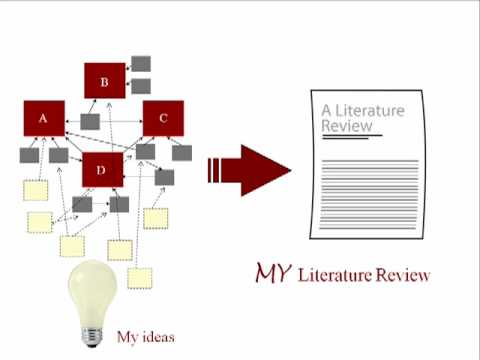
- The literature is a continuously evolving network of scholarly works that interact with each other .
- Major works often form the foundation, with later works building upon, extending, or responding to them .
- As you conduct research, you will begin to understand these relationships and how your own ideas fit into this evolving web .
1.3. Research as a Story and Identifying Gaps
- Research is like telling a chain story, where each writer starts with a partial story created by others and then continues it .
- The existing literature represents "the story so far," meaning you must understand the current state before moving forward .
- However, research is not a single linear story; many different lines of study contribute to the overall narrative you are trying to write .
- Your role in a literature review is to identify the "loose ends" in various fields related to your topic and determine what needs to be done next .
- Just as a good story requires careful background explanation for the reader to understand what is important, researchers need background from the literature to understand their field of study .
- Reviewing the literature is like participating in a conversation .
- By reading and evaluating articles, you understand their connections and the story they tell .
- This process helps you formulate your own response or contribution, turning a network of articles into a coherent review .
2. Types and Process of Literature Reviews
 Literature reviews can vary in scope and purpose, ranging from selective course assignments to comprehensive standalone articles, and involve a multi-step, often non-linear process of research, analysis, and writing.
2.1. Different Types of Literature Reviews
- Literature reviews can be categorized by their scope and whether they are part of a larger work or stand alone .
- Examples of different types of literature reviews include :
- A course assignment is typically a selective review, focusing on a small segment of literature and making up the entire work.
- The literature review in a thesis or dissertation is a comprehensive review that is part of a larger work.
- Most research articles begin with a selective literature review as part of the introduction to establish context.
- Other literature reviews are designed to be fairly comprehensive and stand alone, meaning the entire article is dedicated to reviewing the literature .
- An example of a literature review within an article's introduction discusses important published research on the topic, such as an article on cognitive behavioral therapy .
- A standalone literature review article, like one about employment, explicitly states in its title that it is a review of the literature .
- These in-depth review articles are excellent starting points for research on a topic .
2.2. The Process of Writing a Literature Review
- Writing a literature review involves several key steps :
- Choosing, exploring, and focusing your topic: You might adjust your topic or scope as you learn more from the literature .
- Researching: Use article databases, library catalogs, Google Scholar, and other sources to find scholarly information .
- Evaluating and selecting: Critically assess what you find and choose the most useful articles, books, and publications .
- Reading and critiquing: Read through selected materials to understand, analyze, and critique them .
- Organizing and managing information: Collect information from many sources and use citation management software like RefWorks, EndNote, or Zotero to stay organized .
- Writing and revising: Draft your paper and create your final bibliography .
- This process is not always linear; research or reading may lead you back to earlier steps as you gain more knowledge about your topic and the literature .
2.3. What it Means to "Review" the Literature
- To review the literature means to collect and read all relevant papers and other literature on your topic, providing an overview while highlighting key concepts and important papers .
- The process involves several analytical steps :
- Describing and summarizing each article.
- Making connections by comparing and contrasting papers.
- Evaluating, analyzing, and organizing the information.
- Critically examining articles and books to identify what is important, out of scope, and to analyze arguments for strengths and weaknesses.
- It is crucial to look for relationships between publications, such as major themes, important concepts, critical gaps, and disagreements .
- Avoid simply creating a "laundry list of summaries" or an annotated bibliography; your goal is to integrate and synthesize what you find into something new .
- Ideally, you will create your own conceptual map or outline of the literature on your topic .
- For example, if you discover three major concepts relevant to your research, you should identify how individual publications relate to these concepts .
- The key is to develop and present your own organization and understanding of the literature .
- Your final literature review will be organized by the concepts and relationships you developed, including your own thoughts and ideas, and will tell the specific story that provides background and significance for your research .
2.4. Seeking Assistance
- Writing a good literature review can be challenging, so do not hesitate to seek assistance .
- Resources for help include your adviser or instructor, the campus writing center, or a librarian .
- Librarians, especially those with subject specialties, can be particularly helpful in identifying valuable resources and showing you how to obtain relevant information .
Understand massive materials like a genius — with LilysAI
Over 1,000,000 knowledge seekers use Lilys AI.
AI chat grounded in your uploaded sources