
How to Write a Literature Review
This YouTube insight note was created with LilysAI. Sign up free and get 10× faster, deeper insights from videos.
Q: What is the structure of a literature review for an article?
Q: What is a literature review?
What is a literature review and why does it matter? It's a critical summary of published research that establishes the background and significance of your work by identifying gaps and building on existing knowledge.
1. Understanding a Literature Review
A literature review is a critical summary of published research that helps establish the background and importance of a new study by identifying gaps and building on existing knowledge.1.1. Definition and Purpose of a Literature Review
- A literature review is an objective, concise, and critical summary of published research relevant to a specific topic being researched .
- A good literature review organizes articles and books to highlight unresolved debates, inconsistencies, tensions, and questions within a research field .
- It summarizes the most important aspects of scientific literature related to the research area and synthesizes past and current research to show how new research fits in .
- An analogy for a literature review is building a bookshelf: researchers use pieces (existing research) made by others and assemble them to construct their own project .
- The literature review provides background understanding, identifies important studies, and helps assemble the "bookshelf" of a new study .
1.2. Key Components to Include in a Literature Review
- A literature review should include the historical background of the research field .
- This shows what has already been written, allowing the researcher to present new and significant contributions .
- It also demonstrates the researcher's ability to understand and rephrase theoretical concepts .
- The current research context must be included, discussing questions, issues, and debates in the field .
- This contextualizes the work by showing both historical background and the modern state of research, highlighting developments and trends .
- Relevant theories and concepts should be incorporated .
- For example, when researching the relationship between the ecological environment and human population, providing models and theories on this connection helps contextualize the study .
- Relevant terminology should be introduced and defined to show how terms fit into the work's context .
- Related research should be described, showing how the current work expands, challenges, or fills gaps in existing research .
- Supporting evidence for a practical problem or issue addressed by the research should be provided to demonstrate its importance .
- Referencing related research establishes the research area as reputable and shows that the current work builds upon significant previous work .
2. Types and Structure of Literature Reviews
Literature reviews vary in scope and purpose, ranging from selective summaries within larger works to comprehensive standalone analyses, each with distinct structural characteristics.2.1. Different Forms and Purposes of Literature Reviews
- Literature reviews can range from selective (narrow area or single work) to comprehensive (larger amount or range of works) .
- They can exist as part of a larger work or stand alone .
- A course assignment is an example of a selective stand-alone work, focusing on a small segment of literature to form an entire piece .
- A literature review in a dissertation or thesis is comprehensive and part of a larger work .
- Most journal articles begin with a selective literature review to provide context for the research reported in the manuscript .
- Some literature reviews are both comprehensive and stand alone, where the entire article analyzes literature on a given topic .
- The literature review can serve different purposes and take various forms, despite common applications across many document types .
- The two main types of literature reviews found in journals are those in research articles (like studies and surveys) and stand-alone literature analyses .
- These types differ in their scope, length, and specific purpose .
2.2. Literature Review as Part of an Introduction
- A literature review at the beginning of a journal article introduces research related to the specific study and is usually found near the end of the introduction section .
- This type of review is shorter than stand-alone reviews because its scope is limited to very specific studies and theories directly relevant to the current study .
- It often sets research precedent and supports the theory or methods of the current study .
- An example might be a "Related Research" section, typically four paragraphs long, citing four to five sources (about one source per short paragraph), which is standard for introducing an article .
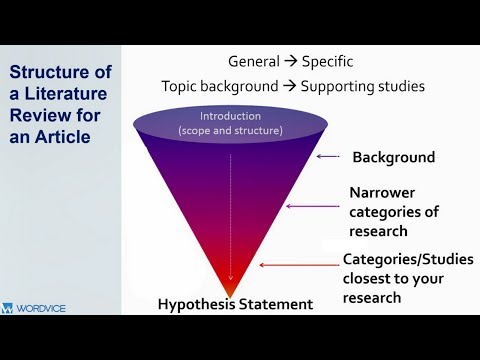
- When part of an introduction, the literature review follows the introduction's structure, moving from general to specific .
- It presents broad background information first, then moves to specific studies supporting the current study, and finally leads to the hypothesis statement .
- The literature review in an introduction is often indistinguishable from the introduction itself, as it introduces the background and defines the gaps the study aims to fill .
2.3. Stand-Alone Literature Review
- A stand-alone literature review is published as its own article and presents and analyzes as much important text in a study area as possible .
- Its purpose is to provide background information and context for a current or future research area or specific study .
- These articles are excellent resources for researchers seeking relevant information on a study area .
- They present and analyze many relevant texts to give a full account of a research topic, approach, or theory .
- They are generally broader in scope and extend further back in time .
- Stand-alone reviews can be highly theoretical .
- They focus on the results and methods of previous studies, often featuring more extended analysis and greater detail .
- All sections of this type of review refer to the literature rather than detailing a specific current study .
- Two distinguishing features of a stand-alone literature review in a journal are:
- The words "literature review" are often included in the title, though not strictly necessary .
- The text is much longer than a literature review introducing a study .
- Headings indicate the type of literature discussed and its contribution to the topic .
- A conclusion explicitly ties all works together, showing how the analysis itself contributes to the literature .
3. The Process of Writing a Literature Review
Writing a literature review is an iterative process that involves choosing a topic, collecting and analyzing scholarly information, summarizing articles, identifying relationships, and connecting ideas to form a coherent narrative.
3.1. Iterative Nature and Initial Steps
- Writing a literature review is not usually a linear process; researchers often need to revisit and reformulate ideas .
- This means the literature review is a continuous work-in-progress, developed before, during, and after a study is complete .
- This iterative process is especially applicable to stand-alone literature reviews but also helps in understanding what to include when introducing a study .
- The first step is to choose a topic to write on, focusing and exploring it .
- The topic should be familiar and interesting to the researcher, appealing and useful to intended readers, current, well-established, and have sufficient existing research for a review .
- This helps find the optimal focus .
- For a journal article introduction, this stage might involve adjusting the scope based on what is learned from the literature .
- Next, research and collect all pertinent scholarly information on the chosen topic .
- "Literature" includes scholarly articles, books, academic conference speeches, dissertations, theses, and any other academic work related to the study area .
3.2. Analyzing and Summarizing the Literature
- After collecting information, analyze the network of information that extends or responds to major works in the area .
- Select the most useful material, using thought maps and charts to identify intersections and outline important categories .
- Describe and summarize each article, providing essential information relevant to the study .
- Determine two to three important concepts discussed in the literature, depending on the article's length .
- Take notes on all important aspects of the study relevant to the topic being reviewed .
- For example, in a heart disease study, main concepts might be atherosclerosis, hypertension, and obesity .
- Note these concepts and write a brief summary of how each article incorporates them, such as "Yang's 1995 longitudinal study of obese patients attempts to measure the effects of chronic hypertension on atherosclerosis" .
- Summaries can be relatively short for reviews introducing a study, but significantly longer for stand-alone reviews .
- After summarizing, demonstrate how these concepts relate to the study's findings or how the literature connects the discussed concepts/topics .
- In a literature introduction, this might include summarizing results or methods of previous studies that correspond to or confirm sections in the current study .
- Researchers might identify missing parts in previous studies that their study addresses, or highlight concepts supporting their hypothesis, methods, results, or conclusions .
- In a stand-alone review, this means highlighting concepts in each article and showing how they strengthen a hypothesis or reveal a pattern .
- For example, researchers can identify unaddressed issues, or what is accurate versus out of scope in previous works .
3.3. Identifying Relationships and Developing Ideas
- The final step is to identify relationships within the literature and connect personal ideas to them .
- This is similar to the previous step but focuses on connections between the literature and the current study's guiding concepts or arguments, not just connections between the works themselves .
- Examining these concepts is like conducting a study, pointing to important information from previous studies and drawing conclusions from their results .
- The researcher's hypothesis, argument, or guiding concept acts as a "golden thread" that ties the works together, giving them importance they wouldn't have outside the review .
- The review will cover publications on the topic and include the researcher's own ideas and contributions .
- Following these steps helps tell a specific story that sets the background and shows the significance of the research, transforming a network of related works into a focused literature review .
4. Practical Considerations for Literature Reviews
The length and number of sources in a literature review depend on the scope and depth of the topic, while effective strategies include defining the audience, reading extensively, prioritizing current literature, and taking detailed notes.
4.1. Length and Number of Sources
- The length of a literature review is determined by the number of sources reviewed, the concepts explored, and the tension between these concepts .
- A stand-alone literature review can range from 2-3 pages to an entire book .
- For a literature review within a separate article, this section is usually no more than 2-4 paragraphs .
- The number of sources reviewed depends heavily on the topic's breadth or narrowness, the desired depth of exploration, and the level of consensus or disagreement in the area .
- In a stand-alone review, the number of works might be 5 to 15, or up to 30 or more in a full book-length review .
- A journal article usually has fewer than 5 sources, focusing on the most important points without going into great depth .
4.2. Tips for Creating a Stronger Literature Review
- Define the topic and audience before starting research to help decide which works to include .
- Read many journal articles, especially those in the area of interest, to understand how to structure and order the review .
- Focus on more current literature, particularly for studies and articles .
- Older theories are acceptable if they are fundamental and provide a stable foundation that hasn't changed, but current research is highly valued .
- Take ample notes while researching texts .
- Using note cards, tables, or computing programs like Microsoft Excel helps organize and index information for easier categorization .
- It is crucial to write down exactly why texts are relevant rather than just stacking them .
Understand massive materials like a genius — with LilysAI
Over 1,000,000 knowledge seekers use Lilys AI.

AI chat grounded in your uploaded sources