Srijika: OpenType Layout - Reusing Font Restyling for Nine Indic Scripts

0. Abstract
arXiv:2609.05661 · Anil Pai
| Core | A system for generating installable Indic fonts by restyling template glyphs via retrieval-grounded latent diffusion. |
| Gap | Generative models produce images, not fonts; Indic scripts require complex, professionally-engineered shaping-engine contracts. |
| Approach | Restyles glyph outlines of shaping-complete templates while retaining original GSUB/GPOS layout machinery and using a defect-tolerant verification pipeline. |
| Result | Ships 66 TTFs across nine scripts; zero-shot SSIM gates range from 0.686 to 0.786, with cluster accuracy 0.981–1.000. |
The Question — How can OpenType fonts for Indic scripts be restyled efficiently without generating them from scratch, while ensuring layout consistency and addressing data scarcity?
- Srijika is a system that produces installable OpenType fonts for nine Brahmic scripts.
- The scripts include Devanagari, Tamil, Bengali, Telugu, Kannada, Malayalam, Gujarati, Gurmukhi, and Odia.
- The system restyles glyph outlines of existing template fonts instead of generating fonts from scratch.
- This approach reuses the template's
cmapandGSUBclosure, as well as itsGPOSdata under a documented metric policy. - This ensures that every output is a valid font by construction.
- This approach reuses the template's
- Srijika ships 66 TTFs, including 57 curated presets and nine open-vocabulary showcase fonts.
- All fonts pass the OpenType Sanitizer.
- HarfBuzz and CoreText reproduce the template's glyph-ID sequences for conjunct-heavy probes on every font.
- A full-closure audit of 80,915 glyphs and 54,812 anchors quantifies every metric delta.
- Style selection uses natural language through Lipika, a retrieval index over approximately 650 open-license families.
- Lipika grounds a prompt in a concrete donor face.
- A reference-conditioned latent diffusion model redraws each template glyph in the donor's style.
- A content gate, harmonization pass, and shaped-cluster verify-and-repair loop revert any failing glyph to its template outline.
- Adding a new script requires approximately 20,000 to 48,000 steps with a warm-start graft recipe.
- Per-script routing avoids cross-script dilution caused by grafting.
- Evaluation is performed against no-learning baselines.
- On SSIM gates for diffusion-training-family-held-out data, unrestyled template copy outperforms generation on 50 of 56 faces.
- Style movement is only measurable with an internal, same-model embedding whose training corpus includes the held-out families.
- The median gap closure is 0.05.
- One out-of-distribution (OOD) family, Alkatra, reaches 0.85–0.94 closure, while seven others show minimal movement.
- A learned baseline, an independent style metric, and a human study are outside the scope of this report.
- The contributions include the formulation, the layout-reusing pipeline and its audit, a frozen nine-script ID/OOD benchmark, and a negative-results catalogue.
- The negative-results catalogue details six unsuccessful conditioning/objective levers.
- It also includes a forensic study of train-time objective contamination and a data-hull analysis of when reference-guided restyling fails.
1. Introduction
Brahmic scripts are read by over 800 million people, with India's 2011 Census alone recording over a billion mother-tongue speakers of scheduled languages written in them. However, their typographic ecosystems are significantly smaller than Latin's. For example, Google Fonts hosts over 1,800 Latin families but only six families for Odia script.
- Structural Gap in Indic Font Design
- A text-ready Indic font is a shaping-engine contract, not just a drawing exercise.
- It requires hundreds to thousands of conjuncts, half forms, and matra variants to be present and mutually consistent through OpenType substitution.
- This complexity multiplies the cost of every new design.
- Generative models are an obvious solution, but current approaches that generate glyph images fall short because an image of type is not a usable font.
- Srijika System Overview
- Srijika takes a natural-language style description and outputs an installable TTF for any of nine Brahmic scripts.
- It retains the template's substitution closure and reuses its positioning structure.
- The core design decision is to never generate a font from scratch.
- It restyles the complete glyph closure of a professionally-engineered open-license template font, tile by tile, using a reference-conditioned latent diffusion model.
- Outlines are rebuilt in place, so the template's
GSUBmachinery is reused unchanged. - Its
GPOSstructure is reused subject to documented metric and anchor-coordinate transformations. - Finite HarfBuzz and CoreText probes verify glyph-ID parity with the template.
- Visual positioning quality and exhaustive
GPOSbehavior are outside the current audit.
- Lipika for Style Control
- Style comes from Lipika, a retrieval index over approximately 650 open-license families.
- Lipika's embeddings ground open-vocabulary prompts in concrete reference glyphs.
- Defect-Tolerant Serving Pipeline
- The pipeline includes a content gate with a retry ladder, style harmonization, coherence capping, and shaped-cluster verification with per-glyph repair.
- This converts a model that is usually correct into a font where every glyph either passes verification or reverts to the template outline.
- Contributions of Srijika
- Template-layout-reusing restyling: The template's
cmapandGSUBsubstitution closure are retained unchanged.GPOSstructure is reused subject to documented metric and anchor-coordinate transformations.- Layout is reused, not learned, which decouples restyling quality from layout logic.
- Retrieval-grounded styling (Lipika): Per-(family, script) CLIP-style embeddings convert free-text prompts into reference tiles.
- This sidesteps the lack of Indic style-attribute datasets.
- A graft recipe for scaling one backbone to nine scripts: Training resumes from a shipped checkpoint with uniform pack concatenation.
- An observation of dilution under sequential grafting showed that previously shipped scripts degrade relative to the donor.
- Re-weighted sampling only relocates the loss, rather than removing it.
- Per-script routing serves each script from the checkpoint that first passed its gate, avoiding shipped-script regressions.
- An evaluation protocol for generated Indic fonts: This includes family-held-out zero-shot gates with genre-matched splits, script bars, content probes, and a shaped-cluster critic.
- A frozen two-strata (ID/style-OOD) benchmark with a diffusion-training-disjoint controlled checkpoint is used.
- Benchmark families remain in Lipika's encoder and retrieval training corpus.
- The headline finding is that OOD style transfer is strongly family-specific.
- A negative-results catalogue: This includes six unsuccessful lever families, a forensic study of train-time objective contamination, and a data-hull boundary.
- These characterize failure modes under the architecture, critic, and training regime.
- These are expected to recur in similar reference-guided glyph generators.
- Template-layout-reusing restyling: The template's
2. Related Work
- Few-shot font generation
- Component- and style-disentangling generators (FUNIT, MX Font, DG-Font, CF-Font) and diffusion approaches (FontDiffuser) synthesize unseen glyphs from a few references.
- These methods primarily target Latin and CJK scripts.
- They emit rasters and do not address font assembly or the more complex shaping problem for Brahmic scripts.
- Srijika adopts their reference-conditioning insight but changes the deliverable.
- The unit of generation is a tile in a template's glyph closure.
- The output is an installable font by construction.
- Direct vector-font synthesis
- This parallel approach generates outlines natively in vector space.
- Examples include VecFontSDF, DualVector, VecFusion, and VecGlypher.
- These systems generate vectors natively and avoid a tracing stage.
- They target isolated glyphs, predominantly Latin/CJK.
- None addresses OpenType layout closure, which can exceed a thousand interdependent glyphs per face for Brahmic scripts.
- Srijika chose raster diffusion plus tracing because it composes with any template's closure out of the box.
- Swapping in a native vector generator per tile is compatible with the pipeline and an attractive upgrade path.
- Diffusion conditioning
- Srijika's generator is a latent diffusion model with reference cross-attention, similar to adapter-style conditioning.
- Forensic analysis contradicts the intuition that stronger decode-side content injection improves content fidelity.
- All six unsuccessful levers targeted decode-side fidelity.
- Evidence suggests training data coverage and objective hygiene are the binding constraints.
- A learned few-shot baseline (e.g., FontDiffuser) was not run, so this reading is scoped to Srijika's architecture.
- Font retrieval and attributes
- Attribute-based font selection and CLIP-based font embeddings (FontCLIP) are trained on Latin attribute data.
- These show reported zero-shot generalization to other scripts.
- No purpose-built Indic resource existed.
- Lipika fills this gap with per-(family, script) embeddings over an Indic corpus.
- It uses a CLIP-LoRA tower for donor retrieval.
- A family-recognizer backbone serves as the generator's style encoder and the critic's style metric.
- Indic text shaping
- Correct rendering of Brahmic scripts is codified in Unicode and implemented by HarfBuzz.
- Srijika relies on this in two ways:
- Templates are chosen from fonts with professionally validated shaping.
- The cluster critic reshapes generated fonts through HarfBuzz to check visual plausibility after restyling.
3. Problem Setting: Nine Brahmic Scripts
Brahmic scripts significantly increase the difficulty of font generation across three axes.
- Closure Size and Shaping
- A text-ready font is the layout closure of its script blocks, not just a set of codepoint glyphs.
- This includes conjunct ligatures, half forms, matra variants, and contextual substitutes reachable through
GSUB. - Closure sizes vary by an order of magnitude across scripts.
- Mukta Mahee's Gurmukhi closure is 210 glyphs.
- Baloo Da 2's Bengali closure is 1264 glyphs.
- Any generated font must maintain this machinery, or clusters will visibly break.
- Data Scarcity with Genre Skew
- The open-license corpus assembled spans approximately 650 families across nine scripts.
- Per-script family counts range from 250 (Devanagari) down to 7 (Odia).
- Display and decorative genres are almost absent outside the largest scripts, which are precisely the styles users request.
- Visual Regime
- Matras, stacked conjuncts, and headstrokes (śirorekhā) mean that per-glyph plausibility is insufficient.
- Errors only become apparent when shaped text is read as clusters.
- This motivates Srijika's cluster-level verification.
- Corpus Sourcing and Licensing
- The corpus is drawn from Google Fonts (OFL/Apache), SMC, and community foundries.
- Every training font, template, and donor is open-licensed.
- Generated fonts carry OFL-compliant renames, crediting their template.
4. The Srijika System
4.1. Template glyph replacement
Key Mechanism — Srijika restyles existing template fonts by replacing individual glyph outlines, ensuring that the complex OpenType layout data is preserved and reused, rather than generated from scratch.
- Restyling Process
- Given a natural-language style description, Srijika does not synthesize a font from scratch.
- It restyles a curated, shaping-complete template font.
- For each glyph outline in the template's script closure, a generative model redraws the glyph in the target style.
- The new outline is traced back into the template's
glyftable.
- Layout Data Preservation
- The
cmapandGSUBlookup data of the template are retained unchanged. GPOSlookup structure and feature routing are retained.- Anchors belonging to a translated outline are moved by the same vector.
- Pair-positioning values are retained according to a documented metric policy.
- The
- Shaping Engine Decisions
- Because glyph selection is driven by
cmapandGSUB, a shaping engine makes the same glyph-selection decisions for the output font as for the template. - Visual quality of the restyled outlines is a separate question, handled by verification.
- Because glyph selection is driven by
- Problem Transformation and Fallback
- This converts an open-ended font-engineering problem into a per-glyph image translation problem with a structural floor.
- A rejected glyph reverts to its professionally drawn template outline.
- Accepted generated outlines remain subject to the limits of the internal critic.
- Formal Process and Metric Policy
- Let
Tbe the template with script glyph closureG(T) = {g1, ..., gn}.G(T)is computed by subsetting with layout closure over the script's Unicode blocks.
- Let
R = {r1, ..., r6}be six reference tiles rendered from a donor font carrying the target style. - A conditional generator
fθ(gi, R)produces a restyled raster tile for everygi. - This tile is thresholded, vectorized, and re-inserted into the template's glyph slot.
- Metrics are derived from the template's, with a raster-space baseline alignment before vectorization.
- The advance widens only when the restyled outline is fatter.
- Ink falling left of the template's sidebearing floor is shifted right, with the glyph's
GPOSanchors translated by the same vector. - Pair-positioning values are retained unchanged.
- This policy keeps positioning data consistent with moved outlines.
- It does not guarantee that every attachment remains visually appropriate for a redesigned stroke or terminal.
- Anchor-to-ink and collision auditing are future work.
- Output advances differ from the template's only by these policy-defined widenings.
- Measured extrema are not typographic safety bounds.
- One audited template per script was sufficient to reach fidelity gates.
- This bounds layout-scale style transfer.
- Candidates are audited by glyph closure size and
GSUBcompleteness.- Meera has 1153 glyphs for Malayalam.
- Baloo Da 2 has 1264 glyphs for Bengali.
- Mukta Mahee has 210 glyphs for Gurmukhi, which are structurally small due to few conjuncts.
- Let
4.2. Lipika: grounding language in a donor font
Open-vocabulary style control is handled by retrieval. Lipika consists of two image models trained on the same Indic font corpus.
- Lipika's Recognizer Model
- The first model is a recognizer: a ConvNeXt-V2-tiny trained with a sub-center ArcFace head to identify font families from rendered glyphs.
- Its frozen penultimate features serve multiple purposes:
- As the generator's style encoder.
- As the serving critic's style judge.
- As the embedding behind the closure metric.
- This makes the closure metric a same-model measurement.
- Lipika's Language Grounding Model
- The second model grounds language: a CLIP-L text/image tower pair with a LoRA-adapted image tower.
- It is fine-tuned on rendered specimens of the corpus.
- It is indexed with one L2-normalized embedding per (family, script) face.
- A natural language description, such as "warm rounded friendly," retrieves a ranked list of donor faces.
- This list can optionally be filtered by script.
- The top face provides the six style-reference tiles.
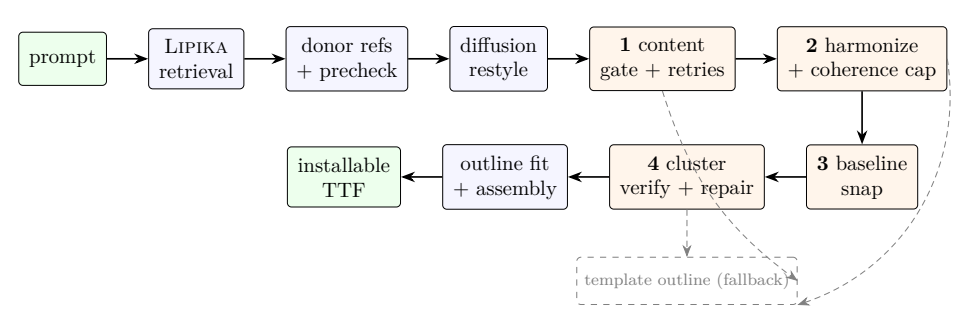 Srijika serving pipeline diagram
Figure 1: The Srijika serving pipeline. A prompt retrieves donor reference glyphs via Lipika; the diffusion model restyles the template’s glyph closure tile-by-tile; four verification stages gate, harmonize, snap, and shape-verify the result, each able to revert individual glyphs to the template outline (dashed) — so every glyph in an output font either passed verification or is the template outline, and the layout program is inherited.
- Training and Properties of the Language Grounding Model
- The tower is trained with a fused attribute-supervision stack.
- Deterministic labels come from foundry metadata.
- Measured stroke-contrast uses EDT ridge widths on rendered specimens, clamping VLM claims.
- Two VLM annotation passes are performed over a 48-attribute vocabulary.
- The shipped checkpoint achieves a mean Spearman correlation of 0.50 between attribute-text similarity and gold labels on held-out families.
- Retrieval grounding offers two advantages over generation from text:
- The style is always realizable because it exists as a font.
- Licensing is auditable per donor.
- The tower is trained with a fused attribute-supervision stack.
4.3. Reference-conditioned glyph diffusion
- Generator Architecture
- The generator is a latent-diffusion UNet with 134 million parameters (132.9 million UNet + 1.2 million style projection).
- It operates over 128 × 128 glyph tiles.
- The template glyph raster enters as a content channel at
conv_in. - Style is injected by cross-attention over pooled embeddings of the six reference tiles.
- These embeddings are computed by the frozen Lipika recognizer backbone.
- Only the 1.2 million-parameter projection onto cross-attention tokens is trained.
- Classifier-free guidance is enabled by token dropout at train time.
- Sampling uses a guidance scale of 3–4.5 and 50 steps.
- The same backbone, trained once and grafted per script, serves all nine scripts through per-script routing.
4.4. Defect-tolerant serving pipeline
Raw per-glyph generation is not shippable. Srijika wraps it in four verification-and-repair stages, each with a template-fallback exit.
- Content Gate + Retry Ladder
- A retrieval-based content-identity critic checks if each generated tile still reads as its source glyph.
- Failing glyphs retry down a guidance ladder.
- Unrecoverable glyphs retain the template outline.
- The critic is a serve-time filter only; adding it as a train-time loss destroys training.
- Weight Harmonization with a Bounded Coherence Cap
- Per-glyph stroke-weight outliers (log ink-ratio deviations, MAD-scaled) are regenerated with direction-aware guidance ladders.
- Thin outliers retry at higher guidance.
- Thick outliers retry at lower guidance.
- A counter-fill guard (border flood-fill hole area) catches blobbed counters that erosion statistics miss.
- A blended-median coherence cap reverts any glyph to the template if it remains > 1.35× above the fleet median weight.
- The cap has bounded authority: if more than 25% of styled tiles are flagged, the heaviness is considered the style itself, and the cap stands down.
- Per-glyph stroke-weight outliers (log ink-ratio deviations, MAD-scaled) are regenerated with direction-aware guidance ladders.
- Baseline Snap
- Per-glyph vertical jitter is canceled in raster space before vectorization.
- Row-profile cross-correlation against the content raster measures each glyph's vertical drift.
- The font-wide median drift is kept as style.
- The residual jitter adjusts the trace offset.
- Outlines enter the template's coordinate system already normalized.
- No positioned outline is moved vertically afterward.
- The template's anchor y-coordinates remain unchanged by baseline normalization.
- The audit confirms
∆y ≡ 0across all 54,812 anchors.
- Whether unchanged coordinates remain visually appropriate for redesigned ink is a separate question, evaluated only through the shaped-cluster critic so far.
- Horizontal sidebearing shifts occur in vector space and explicitly translate anchors.
- Shaped-Cluster Verify and Repair
- The assembled font is shaped with HarfBuzz over the script's cluster inventory.
- Clusters that no longer read correctly (content critic on the shaped raster) have their constituent glyphs greedily reverted to template outlines until the cluster reads again.
- Fleet-wide, this converges at a cluster accuracy of 0.981–1.000 with 7–110 reverted glyphs per font.
- A donor precheck measures the donor's bbox-normalized ink density and warns when it exceeds the training hull.
- OFL-compliant renaming credits the template.
4.5. Parametric post-axes
Shipped fonts expose three outline-space parametric axes applied directly to the TTF.
- Available Axes
- Weight
- Counter
- Em-fill
- These axes provide users with a small design space around each generated style without re-sampling the model.
5. Training: One Graft Recipe, Nine Scripts
5.1. Pair packs and curated splits
- Training Data Generation
- Training data is generated from the corpus itself.
- Within each family, (content, style) tile pairs are rendered.
- The content channel comes from the script's template.
- The target comes from a corpus font, over per-script shaping-aware unit inventories (aksharas, conjuncts, matra combinations).
- Packs per script range from approximately 8,000 to 300,000+ pairs across 7–250 families.
- A glyph-level auxiliary pack (single codepoints rendered per font) hardens coverage.
- A script-sniffing bug taught the importance of validating per-script Unicode ranges first.
- Glyph-OK rates were 62–87% when correct.
- Rates were 2–3% when silently falling back to Devanagari codepoints.
- Split Curation and the Modak Rule
- Split curation is more important than volume.
- The deployment policy, known as the Modak rule, keeps decorative/display families in the training split.
- These families were unlearnable zero-shot in runs and depressed fresh-script baselines when placed in test.
- The Odia expansion provides a two-run demonstration:
- With the decorative Alkatra family in test, the script gated at 0.6541 SSIM.
- Its reconstruction grids looked structurally correct, and a normal-genre validation family scored 0.720.
- Re-splitting Alkatra into train and a serif family into test, then retraining with the same recipe and initialization, yielded a 0.7622 zero-shot gate.
- Both runs resumed the same v3.7 checkpoint, differing only in split membership.
- The +0.108 delta is a benchmark-composition difference, not a like-for-like model improvement.
- Test distribution and training membership both changed.
- An instrumented re-run of both conditions (Table 1) sharpens the reading.
- For the held-out Alkatra family, generated Lipika gap closure is 0.866 (seed-stable at 0.866/0.861/0.867).
- This compares to 0.009 for tile-space geometric transform and 0.008 for morphology.
- The two-family OOD-condition macro is 0.450.
- This closure is comparable to, not exceeding, the largest in-distribution family closure (0.98).
- It occurs while SSIM falls below even template copy.
- This provides qualitative support that the Alkatra case exhibits visibly larger local restyling and high internal Lipika closure, despite lower SSIM.
- The in-distribution SSIM gate penalizes this case rather than rewards it.
- The epistemic status is noted: this is a post-hoc test-set change, applying a rule established earlier on Devanagari rather than tuned per script.
- Both numbers are reported: 0.6541 with the decorative family held out (an out-of-distribution challenge set) and 0.7622 genre-matched.
- Operationally, the Modak rule is a split policy.
- Scientifically, excluding difficult genres from test is not a satisfying evaluation design, as decorative styles are precisely what users request.
- This post-hoc Odia case motivates a controlled two-strata protocol with genre-matched and style-OOD families reported side by side.
- Table 1 records the historical Odia study.
benchmark_v1is the controlled nine-script realization.- It includes a versioned benchmark manifest with one decorative/display OOD family per script (Modak for Devanagari, Alkatra for Bengali and Odia, Akaya for Telugu and Kannada, Coiny, Chilanka, Shrikhand, Langar).
- It also includes existing genre-matched ID families, templates, reference-selection rules, seeds, metrics, and SHA-256 hashes.
- Section 7 reports the single-model two-strata evaluation on it (Table 5).
- Figure 3 shows the resulting held-out reconstructions.
| Condition | Held-out family | Faces | Gen SSIM | Tpl. copy SSIM | Morph SSIM | Geom SSIM | Gen Lipika closure | Geo Lipika closure | Morph Lipika closure |
|---|---|---|---|---|---|---|---|---|---|
| OOD (gen-v3.11) | Alkatra | 5 | 0.6377 | 0.6997 | 0.6922 | 0.7101 | 0.866 | 0.009 | 0.008 |
| Lohit Oriya | 1 | 0.7364 | 0.7619 | 0.7628 | 0.7325 | 0.034 | 0.020 | -0.003 | |
| condition macro | 0.6870 | 0.7308 | 0.7275 | 0.7213 | 0.450 | 0.014 | 0.002 | ||
| Genre (gen-v3.11b) | Noto Serif Oriya | 5 | 0.7689 | 0.7917 | 0.7903 | 0.7608 | 0.025 | 0.006 | 0.007 |
| Lohit Oriya | 1 | 0.7290 | 0.7619 | 0.7628 | 0.7325 | 0.026 | 0.020 | -0.003 | |
| condition macro | 0.7490 | 0.7768 | 0.7766 | 0.7466 | 0.026 | 0.013 | 0.002 |
Table 1: Odia split-composition study, by held-out family. Two training runs with the same recipe and initialization (gen-v3.11 / gen-v3.11b, both resumed from v3.7), differing only in which family is held out. All methods under the instrumented protocol of Sec. 7: family-mean SSIM for generation, template copy, target-oracle morphology, and the reference-only tile-space geometric transform, plus family Lipika similarity gap closures for generation, geometry, and morphology.
The OOD row shows qualitative support, not controlled validation. SSIM ranks the visibly style-moving output below template-like structure, while neither tested baseline reproduces the movement.
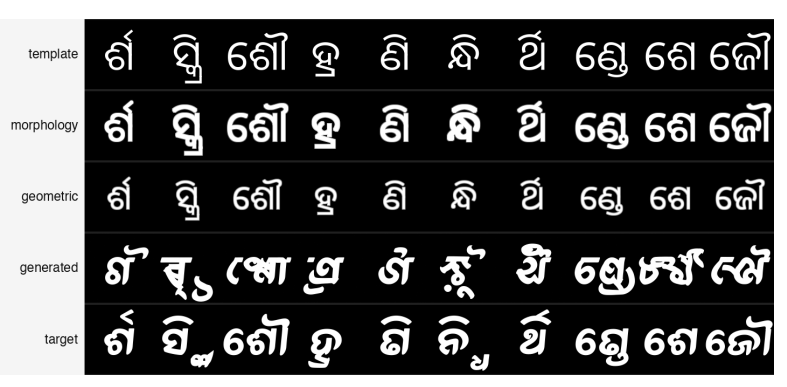 OOD condition qualitative results
Figure 2: The OOD condition, qualitatively. Top: the held-out Alkatra wght700 face under gen v3.11, rows labeled in-figure: template, target-oracle morphology, reference-only tile-space geometric transform, generated tiles, and the Alkatra ground truth. Morphology and geometry barely move from the template — consistent with their near-zero Lipika closures in Table 1 — while generation visibly adopts the donor’s heavy rounded style at a structural cost that SSIM penalizes. Bottom: a HarfBuzz-shaped specimen of a font assembled from the same held-out checkpoint and conditioning as the raster rows (gen-v3.11, seed 7, guidance 3, template Noto Sans Oriya wght400, the eval protocol’s six Alkatra-wght700 reference tiles): 210 of 562 closure glyphs passed the content gate and are restyled, the remainder revert to template outlines — the visible weight mixing is the pipeline’s honest OOD behavior, not a curated production preset. The artifact passes ots; SHA-256 03560c71c59f9614… in the supplement manifest.
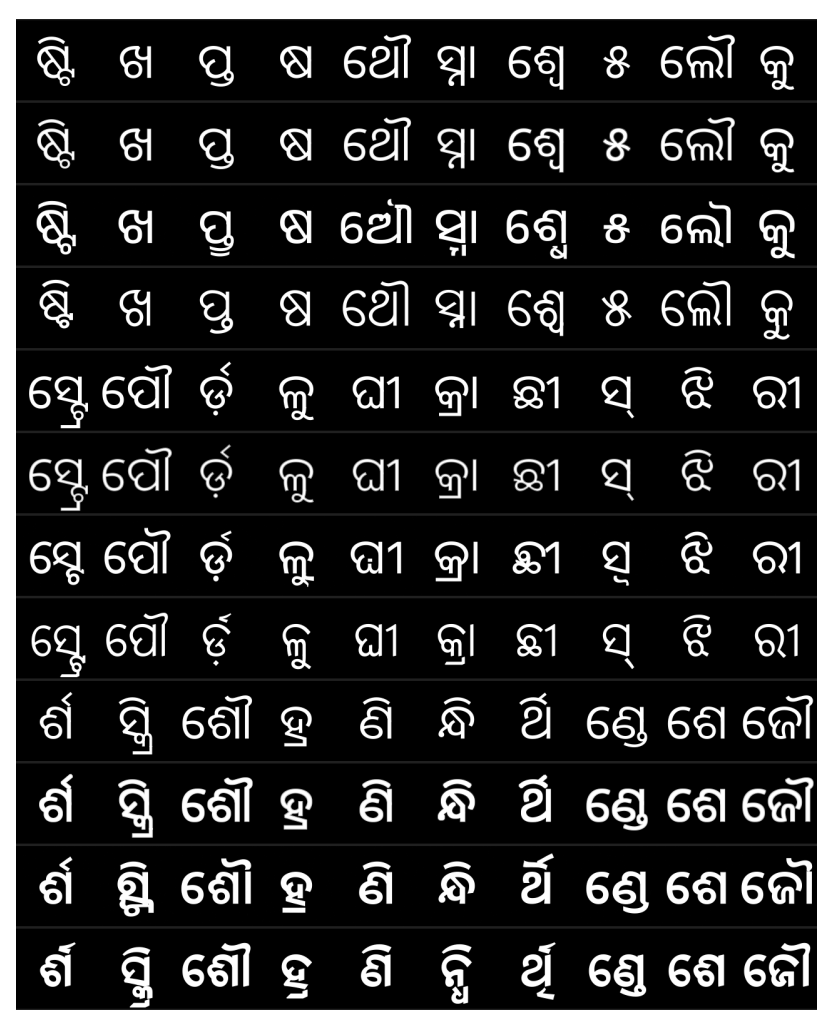 Zero-shot reconstruction of held-out Odia faces
Figure 3: Zero-shot reconstruction of held-out Odia faces (gen-v3.11b; Lohit Oriya and two Noto Serif Oriya weights). Each block shows, top to bottom: the template glyphs (model input content), the target-oracle morphology reference (template dilated/eroded to the target’s ink coverage), generated tiles conditioned on six reference glyphs from the unseen family, and the ground-truth target. Template and morphology are nearly indistinguishable; the generated row moves stroke weight, terminals, and contrast toward the target.
5.2. Warm-start grafting
- Grafting Recipe
- Every script after the first three is added using the same recipe.
- Training resumes from the latest passing checkpoint (weights, optimizer, EMA).
- The new script's packs are appended to the mix by uniform concatenation.
- Training continues for a 20,000–48,000-step window with a cosine LR restart (peak ≈ 2.3×10⁻⁵, floor 0.05×).
- Performance and Efficiency
- New script quality tracks the donor checkpoint's competence.
- Gurmukhi and Odia entered at 0.7861 and 0.7622 zero-shot SSIM, respectively.
- These scores were above several first-generation script baselines.
- Each script required approximately 7 GPU-hours on a single H100.
5.3. Dilution under grafting and per-script routing
- Cost of Grafting: Dilution
- Grafting incurs a cost: when appended data is a large fraction of the mix (e.g., +42% for Malayalam+Gujarati), most previously shipped scripts degrade relative to the donor.
- This degradation occurs at both window lengths tested (Table 2).
- The degradation is not monotone in window length.
- Tamil and Kannada partially recover between +20,000 and +30,000 steps, with Kannada reaching just above the donor.
- A longer window is not a reliable fix.
- Re-weighted sampling only relocates the dilution (zero-sum) rather than removing it.
- This regularity is termed dilution, observed under one architecture, capacity, data order, and schedule, not a universal law.
- Response: Per-Script Routing
- The response is per-script routing: each script is served by the checkpoint that first passed its gate.
- v3.7 for the first five scripts.
- v3.8b for Malayalam/Gujarati.
- v3.11b for Gurmukhi/Odia.
- Routing is an engineering choice, not a finding.
- A shipped checkpoint is never updated, so it cannot regress.
- It costs one resident model per graft generation.
- The scientific question of a single model that adds scripts without dilution remains open.
- The response is per-script routing: each script is served by the checkpoint that first passed its gate.
| Script | v3.7 (donor) | v3.8 (+20k) | v3.8b (+30k) | v3.12 (+30k, wtd.) |
|---|---|---|---|---|
| Devanagari | 0.7476 | 0.7458 | 0.7408 | 0.7408 |
| Tamil | 0.7570 | 0.7493 | 0.7532 | 0.7498 |
| Bengali | 0.7687 | 0.7558 | 0.7534 | 0.7587 |
| Telugu | 0.7691 | 0.7824 | 0.7790 | 0.7828 |
| Kannada | 0.6860 | 0.6714 | 0.6887 | 0.6803 |
| Malayalam | — | 0.7346 | 0.7401 | 0.7298 |
| Gujarati | — | 0.7022 | 0.7019 | 0.7024 |
Table 2: Dilution under grafting. Grafting Malayalam+Gujarati (+42% pairs, uniform sampling) onto gen-v3.7 (@120k) degrades most previously shipped scripts relative to the donor at both window lengths, while new scripts improve.
The degradation is not monotone in window length, and re-weighted sampling only shifts mean SSIM by approximately 0 versus v3.8b, relocating damage to down-weighted scripts. In these runs, dilution is zero-sum.
6. Evaluation Protocol
- Zero-shot gates
- Each script holds out complete font families (not individual weights) as a test split, genre-matched per the Modak rule.
- During evaluation, the model restyles the script's template glyphs using six reference tiles from each held-out family.
- It scores SSIM between generated and ground-truth tiles over the script's unit inventory at guidance 3.
- Reference tiles are drawn from a disjoint subset of the unit inventory and are never among the scored targets.
- Table 3 reports means pooled over all generated tiles of the held-out faces.
- Tiles within a face and faces of one family are correlated, so pooled statistics overstate the effective sample size.
nis families: 2–4 per script.- Faces are 2–12.
- Table 3 also reports family counts and family-level macro averages.
- Appendix B reports every held-out face individually.
- The design is balanced at 64 tiles per face, so the pooled mean equals the face-level macro-average.
- Template-copy and density-matched morphology references, and a reference-only geometric baseline, are scored on the same targets.
- This gate isolates reference-conditioned reconstruction under oracle donor references.
- The donor is a real held-out font, removing prompt retrieval from the loop.
- It neither bounds nor measures end-to-end prompt-to-font quality.
- The end-to-end critic and designer review provide only partial evidence.
- A controlled human evaluation of prompt-to-font output remains future work.
- Script bars
- A script's bar is the gate score of the first model that shipped it.
- No later model may serve a script below its bar (quality-over-cost rule).
- This turns every subsequent training run into a regression test across all shipped scripts.
- Content probes
- Two calibrated Latin display donors (Lobster: heavy-but-inside-hull; AlfaSlab: beyond-hull) probe content survival under aggressive styling.
- Metrics include initial wrong-glyph counts and template-fallback rates under the serving gate's retry ladder.
- End-to-end critic
- Shipped fonts are scored by donor style match (embedding cosine), legibility fraction, and shaped-cluster accuracy after repair.
- Specimens are additionally proofed visually.
7. Results
| Script | Fam. | Faces | SSIM | Fam. macro | Tpl. copy | Morph | Geom | Serving model |
|---|---|---|---|---|---|---|---|---|
| Devanagari | 3 | 12 | 0.7476 | 0.7371 | 0.7913 | 0.7919 | 0.7787 | gen-v3.7 |
| Tamil | 2 | 3 | 0.7570 | 0.7674 | 0.7598 | 0.7628 | 0.6918 | gen-v3.7 |
| Bengali | 2 | 4 | 0.7687 | 0.7694 | 0.7810 | 0.7781 | 0.7653 | gen-v3.7 |
| Telugu | 4 | 8 | 0.7691 | 0.7542 | 0.7797 | 0.7972 | 0.8356 | gen-v3.7 |
| Kannada | 2 | 11 | 0.6860 | 0.6980 | 0.7546 | 0.7545 | 0.7481 | gen-v3.7 |
| Malayalam | 4 | 7 | 0.7401 | 0.7397 | 0.7816 | 0.7820 | 0.7991 | gen-v3.8b |
| Gujarati | 2 | 2 | 0.7019 | 0.7019 | 0.7260 | 0.7199 | 0.7245 | gen-v3.8b |
| Gurmukhi | 2 | 3 | 0.7861 | 0.7779 | 0.8041 | 0.8077 | 0.7736 | gen-v3.11b |
| Odia | 2 | 6 | 0.7622 | 0.7490 | 0.7867 | 0.7858 | 0.7561 | gen-v3.11b |
Table 3: Shipped zero-shot gate scores: an in-distribution, genre-matched operational gate (SSIM over held-out families, test split, guidance 3), read against three no-learning references — template copy, density-matched morphology, and the coherent reference-only geometric baseline — plus the per-script serving route.
The table shows that the serving model for each script meets or exceeds its inherited bar.
- Zero-shot gates
- Table 3 reports the shipped matrix.
- Three regularities are observed:
- Scores track test split genre composition more than script complexity.
- Gurmukhi, added last, posts the highest score because its held-out faces are body-text designs inside the training hull.
- Kannada's test split includes a display cut.
- Held-out sets are small (2–4 families per script), and tiles within a face are correlated.
- Family-level macro-averages are reported alongside pooled means.
- Full per-face scores with p25 tails are in Appendix B.
- Family macro averages move pooled means by at most ±0.015.
- The largest movement occurs where a single family contributes 10 of 11 faces (Kannada).
- With
n=2–4independent families per script, these are descriptive statistics, not estimates with useful confidence intervals.- Sampling-seed reruns with two additional diffusion seeds move pooled per-script means by at most 0.006 SSIM (Table 6).
- Under these small descriptive test sets, the grafted scripts' (Malayalam through Odia) family-macro gate scores overlap the range of the original five under the identical protocol.
- Scores track test split genre composition more than script complexity.
- Template-copy baseline and a target-oracle diagnostic
- The do-nothing baseline scores the unrestyled template glyph against the same held-out targets.
- It posts higher pooled SSIM than the model on every script (by 0.003–0.069) and on 50 of 56 held-out faces (Appendix B).
- A second no-learning reference, density-matched morphology, dilates or erodes each template glyph until its ink coverage exactly matches the target tile's.
- It then scores the morphed tile.
- This isolates how much of the SSIM gap is pure ink-coverage matching.
- It is a target-oracle diagnostic, not a comparable reference-conditioned baseline.
- It reads each scored target's own ink coverage, which the generator never receives.
- Its conditioning is six disjoint reference tiles.
- Its per-tile morphs are independently tuned, so they need not assemble into a coherent font.
- It lands within ±0.018 of template copy on every script (Table 3) and above generated SSIM on 53 of 56 faces.
- Density matching alone neither improves much on the raw template nor lets generation catch up on in-distribution targets.
- This is expected and diagnostic: most held-out faces are body-text designs structurally close to the professionally drawn template.
- SSIM rewards that proximity more than it rewards style movement.
- On the Lipika style metric, generated tiles attain 0.14–0.67 pooled normalized similarity to the held-out face's six-reference centroid.
- This compares to 0.06–0.17 for the unrestyled template under the same normalization (Appendix B).
- At the family level, the paired comparison separates the two questions and gives a sober magnitude.
- Generated tiles sit closer to the reference centroid than the template on 18 of 23 held-out families.
- The median Lipika similarity-gap closure is only 0.047 (IQR 0.016–0.133).
- 8 families exceed 0.10.
- 3 families exceed 0.25.
- 1 family exceeds 0.5.
- 5 families are negative (minimum −0.101).
- Generation improves the internal Lipika style score on most held-out families.
- The median family closes under 5% of the template-to-target similarity gap.
- Large closures concentrate in a few families (Karla Tamil Upright 0.40, Meera Inimai 0.98, RIT TN Joy 0.26).
- Template copy retains higher SSIM on 20 of 23 (Table 6).
- The model moves style at some structural cost, typically by a small amount.
- These statistics are seed-stable.
- Across three sampling seeds, the median closure is 0.047/0.054/0.047.
- Counts above 0.10 and 0.25 are unchanged.
- Exactly one near-zero family (Lohit Malayalam) flips sign.
- The morphology reference's style cosine tracks the template's within 0.08 on every family.
- This style movement is not reproduced by the tested ink-coverage-matched morphology diagnostic.
- Coherent reference-only geometric baseline
- This third no-learning reference estimates one global parameter set from the six reference tiles alone.
- Parameters include ink-bbox x/y scale (clamped to [0.8, 1.25]) plus one fractional morphological weight radius.
- This is the same conditioning the generator receives.
- It applies this parameter set to every template tile.
- Structurally, it is competitive.
- It exceeds generated SSIM on 17 of 23 families.
- It exceeds template copy on 10 of 23 (pooled per script 0.69–0.84, Table 3).
- On style, it is not competitive.
- Its median Lipika similarity-gap closure is 0.006 (IQR −0.004–0.027, maximum 0.218, none above 0.25).
- Generation has a 0.047 median and 3 families above 0.25.
- Generation out-closes it on 17 of 23 families (Table 6).
- The style movement diffusion delivers is not explained by global scale-and-weight geometry.
- Richer parametric families (contrast, slant, per-stroke modulation) remain untested.
- Where a held-out face departs far from the template, the SSIM ordering flips (Meera Inimai: +0.043 over template copy, +0.039 over morphology, at style ratio 0.98).
- Table 3 is read through its baselines: the gates are in-distribution regression tests, meaningful for run-over-run comparison (bars, Table 2).
- They are not evidence that generation out-reconstructs copying on typical body-text targets.
- They are not a measure of open-vocabulary output quality.
- This third no-learning reference estimates one global parameter set from the six reference tiles alone.
- Controlled two-strata benchmark
- To remove the post-hoc confound of the Odia study (Table 1), one model was trained from scratch on the frozen
benchmark_v1manifests (gen-bench-v1).- This involved all nine packs uniformly concatenated, 168,000 steps, no resume, and no auxiliary losses.
- Every script's ID, OOD, and validation families were simultaneously excluded from diffusion pair-pack training.
- Both strata were evaluated under identical weights, references, seeds, and baselines (Table 5).
- Scope notes:
- The OOD families were retrospectively selected (Alkatra's behavior was known before the manifest was written) and subsequently frozen.
- This is controlled reproduction, not a preregistered discovery test.
- Seed columns vary inference sampling only, and
gen-bench-v1is one training run (training-seed replication was not run). - The 168,000 step budget and final-checkpoint rule were fixed in the frozen manifest before training.
- Test strata were never inspected during diffusion-model fitting or checkpoint selection.
gen-bench-v1is a controlled research checkpoint for studying generalization to families held out of diffusion training, not the routed production model.
- The OOD families were retrospectively selected (Alkatra's behavior was known before the manifest was written) and subsequently frozen.
- Three findings:
- The Alkatra case reproduces under control.
- The same held-out multilingual Alkatra family produces high closure in both its Bengali (0.935) and Odia (0.853) script renderings.
- These are correlated script-level observations of one style family, not independent family replications.
- They are seed-stable, with geometry and morphology at ≤0.011, while SSIM stays below template copy.
- The pattern of Table 1 is not an artifact of comparing two separately trained runs.
- OOD style movement is family-specific, not category-general.
- The other seven unique OOD families (Modak, Coiny, two Akayas, Chilanka, Shrikhand, Langar) close a median of 0.040 (range −0.034–0.062).
- The decorative stratum is not uniformly transferable from six references.
- Alkatra's heavy rounded style is the outlier the model imitates well, cautioning against generalizing any single OOD case.
- Freezing both strata did not collapse in-distribution behavior.
- The frozen model's 22 ID families post a closure median of 0.118 with SSIM−template deltas (median −0.023) matching the shipped models' band.
- Direct ranking against the serving chain is confounded by different training budgets and mixes, so both are reported without ranking.
- The Alkatra case reproduces under control.
- One disjointness caveat applies to all closure numbers.
- The exclusions cover diffusion training.
- A family-membership audit finds all 30 benchmark families (and both Alkatra script renderings) inside the 595-family corpus that trained both Lipika image models.
- This includes the CLIP retrieval tower and index, and the recognizer whose frozen features are the generator's style encoder and the closure metric's embedding.
- The judge is a family-identity classifier trained to cluster the very families it scores.
- The generator's conditioning pathway carries a learned representation of them.
- Representational exposure through Lipika is not excluded, and closure remains an internal metric.
- Evaluating with a benchmark-disjoint Lipika retrain and an independent style embedding is future work, as is any human evaluation.
- All 31 family rows, three seeds each, are in Table 5 and the supplement CSV.
- To remove the post-hoc confound of the Odia study (Table 1), one model was trained from scratch on the frozen
- End-to-end generation
- A nine-prompt showcase run (one open-vocabulary prompt per script, retrieval-selected donors) produced nine installable fonts (Fig. 4).
- These fonts had shaped-cluster accuracy of 0.998–1.000 on every script and legibility fraction of 0.82–1.00.
- They restyled 101–681 template glyphs per font (the remainder were shaped-cluster-safe template outlines).
- This took 12–136 minutes on a single L4.
- Across the 57 shipped presets, the serving critic reports cluster accuracy of 0.981–1.000.
- Per-glyph repair reverts a median of approximately 8% of glyphs to the template on the hardest display donors.
- These reverts are concentrated in rare conjuncts where a fallback is visually preferable to a defect.
[Figure] Generated font per script showcase
Figure 4: One generated font per script from a single showcase run, each rendered from its installable TTF with HarfBuzz shaping. Donors span native-script families (Amita, Ekushey Punarbhaba, Kumar One, Baloo Tamma 2, RIT Thaara) and system templates. The Tamil row (donor Oi, an ultra-black face at the data-hull edge, Sec. 8.3) visibly mixes restyled ultra-black glyphs with lighter template fallbacks — the defect-tolerant pipeline providing critic-mediated functional recovery at the cost of visible style consistency: evidence of fallback functionality, not of a coherent type family on this donor.
- Structural validation
- All 66 shipped TTFs (57 presets, nine showcase fonts) pass the OpenType Sanitizer (ots).
- ots is the load-time gate Chromium and Firefox apply to web fonts.
- Layout inheritance was verified cross-engine.
- On conjunct- and matra-heavy probe strings per script, HarfBuzz and Apple CoreText each produce glyph-ID sequences identical to the font's template for all 66 fonts.
- There was no system-font fallback.
- A full-closure audit (every glyph of every font against its template: 80,915 glyphs, 54,812 anchors) quantifies the metric policy's actual footprint, split by provenance.
- The 50,066 template-fallback glyphs carry exactly zero metric deltas.
- Over the 30,849 accepted generated glyphs:
- Advance deltas are p50 0.045 em, p95 0.358 em, maximum 1.93 em.
- Per-script p95 ranges from 0.17–1.11 em, heaviest under Gujarati and Devanagari display donors.
- There are zero narrowed advances closure-wide.
- Accepted-glyph right-sidebearing
|∆|reaches p95 0.142 em (max 1.98). - Outline-extrema p95 is 0.193 (max 0.889).
- Anchor translations are purely horizontal (
∆yidentically zero on all 54,812 compared anchors,|∆x|p95 0.089 em, max 0.44) and track their outline's shift.
- Defining the tail as a >0.35 em advance or right-sidebearing change, 1,617 accepted glyphs (5.2%) exceed it across 61 fonts.
- These are dominated by i-matra width variants under display donors.
- The supplement ships the per-glyph tail list and a SHA-256 manifest of artifacts, templates, and validation logs.
- These are policy-defined widenings, not typographic safety bounds.
- A rendered-context audit of the tail addresses the gap directly.
- Of the 1,617 tail glyphs, 248 are reachable in the shaped unit inventory.
- The rest are feature-context width variants.
- Rendering each reachable glyph in flanked shaped context at 12/24/48 ppem against its template as control finds zero clipping and zero line-fit blowups (advance ratio >2.5×).
- There were 191 raw adjacent-ink overlaps, of which 187 also occur in the template (legitimate tight fit).
- The remaining four generation-introduced overlap cases (in three fonts) were reverted to their template outlines.
- The three fonts were rehashed and revalidated (ots 66/66 still passes).
- The rendered audit was re-run clean.
- Rendered auditing of the 1,369 feature-context only variants (84.7% of the tail) remains open beyond the shaped-cluster critic.
- These are reachable only through
GSUBlookup contexts outside the unit inventory. - This should precede any artifact freeze for a future human evaluation.
- These are reachable only through
- Of the 1,617 tail glyphs, 248 are reachable in the shaped unit inventory.
- FontBakery's universal profile reports the same metadata-policy findings on Srijika fonts as on professional templates.
- It found exactly one generation-introduced defect class: the OFL rename step dropped font-specific name records (IDs ≥256) that the STAT table still references in fonts built on variable-font-instanced templates (Bengali, Kannada, Odia).
- This yielded dangling-reference warnings.
- The rename step now preserves those records, and the shipped files were repaired.
- Only name records changed, so the outline/layout audit remains applicable.
- The metadata-repaired release was rerun through ots and FontBakery.
- ots passes 66/66.
- The ttx-roundtrip failure class drops from 22 fonts to zero with no dangling STAT references.
- Every remaining FontBakery finding class also occurs on the professional template controls.
- This FontBakery comparison was run on the metadata-repaired release and was not repeated after the four outline reverts.
- Those three fonts were re-validated with ots and the rendered-context audit only.
- FontBakery findings describe their pre-revert outlines.
- A SHA-256 manifest of the repaired artifacts, their templates, and the validation logs accompanies the supplement.
- It found exactly one generation-introduced defect class: the OFL rename step dropped font-specific name records (IDs ≥256) that the STAT table still references in fonts built on variable-font-instanced templates (Bengali, Kannada, Odia).
- Scope and versions:
- ots 9.2.0.
- HarfBuzz via uharfbuzz 0.56.0 and Apple CoreText on macOS 26.5.
- Three conjunct- and matra-heavy probe strings per script.
- FontBakery 1.1.0.
- These checks cover sanitizer acceptance, glyph-ID parity, and metric/anchor deltas.
- They do not audit anchor-to-ink attachment quality, cross-glyph collision, or rasterized appearance.
- The shaped-cluster critic audits rendered clusters, but only through HarfBuzz.
- All 66 shipped TTFs (57 presets, nine showcase fonts) pass the OpenType Sanitizer (ots).
- Style axes
- Parametric post-hoc axes (outline offsetting for weight, signed-area counter scaling, em-fill scaling) apply bounded geometric restyling to finished fonts within calibrated safe ranges.
- Weight offset: −40 to +80 font units.
- Counter scale: 0.8–1.2.
- Em-fill: 0.95–1.06.
- These axes result in zero shaped cluster breaks on calibration probes.
- They provide controllable weight and proportion variation that the diffusion model alone does not expose.
- Parametric post-hoc axes (outline offsetting for weight, signed-area counter scaling, em-fill scaling) apply bounded geometric restyling to finished fonts within calibrated safe ranges.
8. Negative Results and Forensics
One-third of this project's GPU budget was spent on levers that failed. These are reported because the pattern they form, and the forensic method used to untangle them, is more transferable than any single positive result.
8.1. Six tested-and-unsuccessful lever families
Five levers targeted content fidelity under aggressive styling, especially with ultra-heavy display donors. The sixth targeted the memory cost of per-script routing.
- Auxiliary content CE on the denoised latent
- This was a train-time classifier pressure toward glyph identity.
- It destroyed global training.
- Skeleton conditioning at
conv_in- A Zhang-Suen skeleton was used as a second content channel.
- The channel died.
- Because the skeleton is a deterministic function of the adjacent raster channel, it carries zero marginal information.
- A zero-initialized channel with redundant signal receives no sustained gradient while weight decay pulls it to equilibrium.
- Final per-channel input norms were 4.25 (raster) vs 0.0125 (skeleton), a 340× gap (Fig. 5).
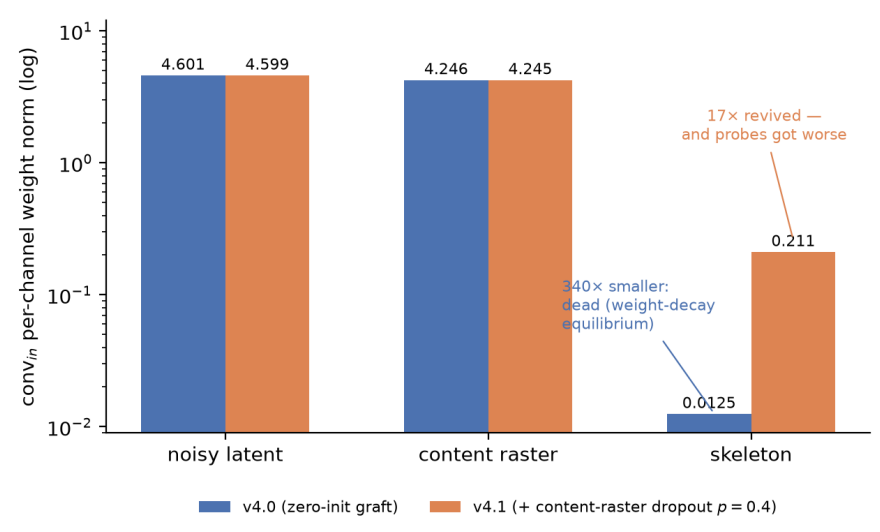 Redundant conditioning dies graph
Figure 5: Redundant conditioning dies. Per-channel conv_in weight norms after 25k graft steps. The zero-initialized skeleton channel (v4.0) settles at weight-decay equilibrium because its signal is computable from the adjacent raster channel. Content-raster dropout (v4.1) makes the skeleton non-redundant and revives the pathway 17× — and heavy-donor probes still got worse, falsifying the structure-deficit hypothesis rather than the mechanism.
5. ControlNet-style grafts work when the control input is not computable from existing inputs. <span class='source-play-button' data-idx='302' aria-label="Script" aria-label="Script">[302]</span> 6. A redundancy-breaking raster-dropout variant revived the pathway (<strong>17× norm recovery</strong>) but still failed gates. <span class='source-play-button' data-idx='303' aria-label="Script" aria-label="Script">[303]</span> - Multi-scale content adapter
- FontDiffuser-style injection was used at every down-block.
- The mechanism verifiably works: adapter head norms were alive at all four scales, and structure flowed with the raster channel blanked.
- However, gates did not improve.
- Conditioning richness was not the binding constraint.
- Weight-domain target augmentation
- Consistent dilation/erosion of target+refs was used to extend the weight range.
- Gates remained flat.
- Self-supervised contrastive style loss
- This involved predicting the reference embedding from the noised target, properly hinged per-sample.
- It taxed fidelity below bars and yielded zero blackness gain.
- Per-pack weighted sampling
- This aimed to unify routing by re-weighting old scripts to their pre-graft share.
- The first two runs collapsed, a verdict later voided when both proved to carry the contaminating auxiliary loss of (1).
- A clean isolation (identical recipe minus the auxiliary term) trained healthily and landed 2/7 gates.
- Mean SSIM shift versus uniform concatenation over the same window was approximately 0.
- Dilution relocated to whichever scripts lost share (Malayalam, squeezed from its 19% natural share to 13%, paid −0.010).
- Weighted sampling is not toxic; it is zero-sum.
- At this model capacity and window length, no share vector clears seven bars simultaneously.
- Routing (Sec. 5) remains the architecture by controlled evidence rather than by default.
| Lever | Attack surface | Mechanism | Deva SSIM | AlfaSlab fb |
|---|---|---|---|---|
| v3.6 baseline | — | — | 0.7445 | 54% |
| Aux content CE | objective | ✓ | 0.553† | —† |
| Skeleton ch. (v4.0) | input cond. | × (dead) | 0.7366 | 56% |
| + raster drop (v4.1) | input cond. | ✓ | 0.7403 | 67% |
| Multi-scale (v5.0) | decoder cond. | ✓ | 0.7363 | 59% |
| Weight aug (v5.1) | data (synth) | ✓ | 0.7214 | 64% |
| Oversample (v5.2) | data (balance) | ✓ | 0.7354 | 54% |
| SCR unhinged (v5.3) | objective | ✓ | 0.6713 | 86% |
| SCR hinged (v5.4) | objective | ✓ | 0.6882 | 53% |
Table 4: Six tested-and-unsuccessful lever families. Mechanism = did the lever verifiably do its job (channel alive, aug applied, loss learning)? Deva = SSIM on the deva test split under the protocol of record (bar 0.7445). AlfaSlab fb = template-fallback rate on an out-of-hull ultra-black donor (baseline 54%).
Every working mechanism either left the fallback rate unchanged or made it worse, while five of eight broke the in-hull gate. The aux-CE row predates the protocol of record and the AlfaSlab probe; its contemporary deva baseline was 0.729, so 0.553 is a 24% collapse. It was the only lever that cut content errors (Lobster fallbacks 157 → 48) by pulling outputs toward classifier centroids, destroying style. v4.0's mechanism check failed (skeleton channel norm 0.0125, 340× below siblings), which is itself the finding.
The pattern arguing against the conditioning hypothesis is the conjunction of the two right-hand columns in Table 4. In every row, the mechanism check passes, but the extreme-donor fallback rate never improves on the 54% baseline. Five of eight variants pay for the attempt with a broken deva gate.
The convergent lesson is that levers (1)–(5) attacked conditioning and objectives, but the model was never asked to draw glyphs beyond its target distribution. The failure lies in the data hull (Sec. 8.3), and none of the tested conditioning levers extrapolated a weight regime absent from targets.
8.2. The aux-loss contamination study
- Contamination Incident
- A train-time content-identity loss (weight 0.1), previously only a serve-time filter, was carried into four consecutive training launches due to a misreconstructed launch configuration.
- All four collapsed with a consistent signature:
- Uniform cross-script SSIM collapse (0.13–0.19 below bars on all seven scripts at once).
- Systematic boldening (generated/target ink ratio 0.963 → 1.036).
- Style washing.
- Validation panels, reconstruction grids, and the loss curve all looked healthy.
- Forensic Investigation
- Controlled reruns cleared three plausible culprits:
- A sampler-free run collapsed identically (not the new sampler).
- A byte-exact rerun of a passing recipe collapsed (not the window or schedule).
- Re-evaluating unchanged checkpoints reproduced their historical scores to four decimals (not environment drift).
- The experiment tracker resolved it: diffing the logged config of passing and failing runs isolated a single delta (
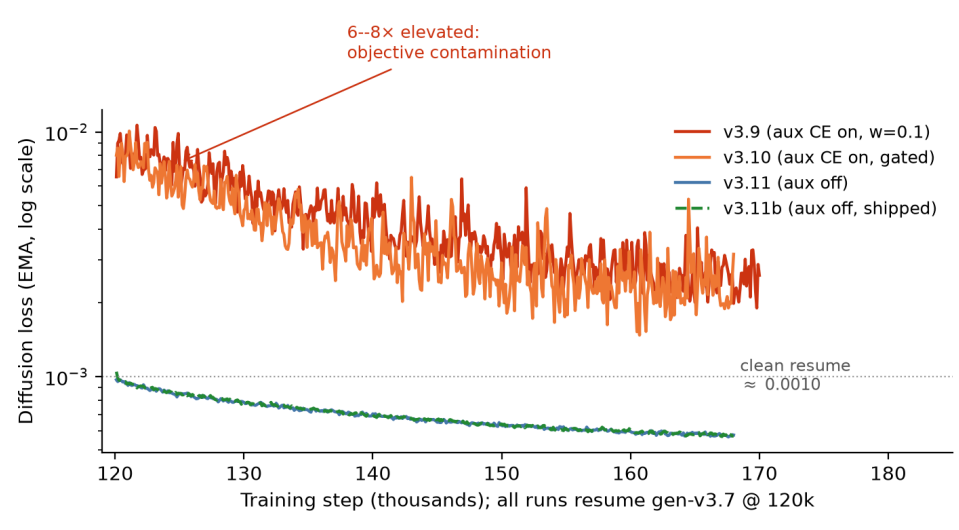
content_ckpt). - The diffusion-term loss at the resume step instantly separated the regimes (Fig. 6).
- 0.0010 clean vs 0.0066–0.0090 polluted.
- The gap is the auxiliary term.
- Controlled reruns cleared three plausible culprits:
 Objective contamination loss fingerprint
Figure 6: Objective contamination has an instant loss fingerprint. Four runs resume the same gen-v3.7 checkpoint at step 120k with the same LR schedule; the only difference is a train-time content-identity CE term (weight 0.1). Contaminated runs (red/orange) sit 6–8× above the clean diffusion-loss regime from the first logged step and never rejoin it; clean runs (blue/green) overlap almost exactly. Gates would not reveal the failure until ∼7 GPU-hours later.
4. Gates would not reveal the failure until approximately <strong>7 GPU-hours later</strong>. <span class='source-play-button' data-idx='337' aria-label="Script" aria-label="Script">[337]</span> 5. A clean relaunch passed its gates on the first try. <span class='source-play-button' data-idx='337' aria-label="Script" aria-label="Script">[337]</span> - Operational Lessons
- Never add a train-time loss term absent from the last passing run's logged config; diff configs before launching.
- Uniform cross-script collapse with healthy panels and systematic boldening indicates objective-function contamination, not data, sampling, or environment.
- The experiment tracker's per-run config and environment snapshot are the forensic record of truth; a launch reconstructed from memory is not a record.
8.3. The data-hull boundary
- Ink Density Measurement
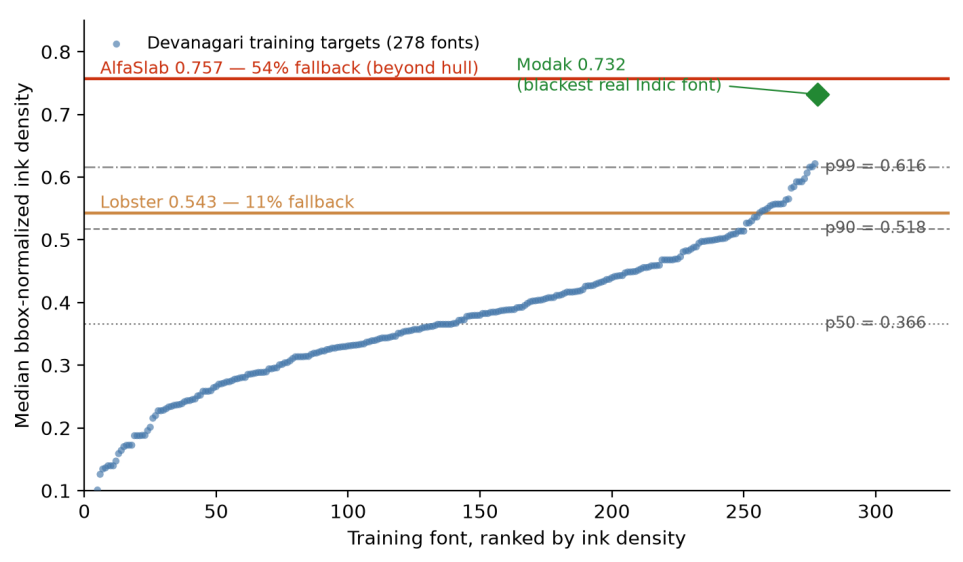
- Per-font median bbox-normalized ink density was measured over all 278 Devanagari training faces.
- Complete families; multi-weight families contribute several faces (Fig. 7).
- Results: p50 0.366, p90 0.518, p99 0.616, maximum 0.732 (Modak, the blackest real Indic font in the corpus).
- Per-font median bbox-normalized ink density was measured over all 278 Devanagari training faces.
 Data hull graph
Figure 7: The data hull. Per-font median bbox-normalized ink density of all 278 Devanagari training faces, ranked. The beyond-hull probe donor AlfaSlab (0.757) is blacker than every training target including Modak (0.732); its 54% content-gate fallback rate was immovable under all six unsuccessful levers. Lobster (0.543, ≈p90) sits inside the hull and restyles with 11% fallback.
- Beyond-Hull Probes
- Under the same metric, the ultra-black Latin donor AlfaSlab measures 0.757, which is beyond every training target.
- AlfaSlab exhibits a structural 54–59% content-gate fallback rate under every lever in this section.
- Lobster at 0.543 (approximately p90) mostly works (11% fallback).
- Serving System Response
- The serving system ships the boundary rather than pretending to cross it.
- A donor ink-density precheck bands each request (normal / heavy / hull edge / beyond-hull) with calibrated expected-fallback warnings.
- Hypothesis and Limitations
- Under this reading, and limited to the architecture, critic, and levers tested, crossing the hull points to targets that do not exist in open-license Indic typography.
- This suggests commissioned glyph sheets are needed, rather than the modeling levers tried.
- The hull is framed as the best-supported hypothesis, not a demonstrated cause.
- Evidence is a single scalar (ink density) and two Latin probe donors.
- AlfaSlab (0.757) exceeds the blackest training face (0.732) only modestly.
- Explanations at other levels (backbone capacity, critic calibration, tile resolution, or the Latin-to-Indic donor gap itself) are not excluded.
- A density-banded multi-donor study would be needed to map the boundary's actual shape.
- Under this reading, and limited to the architecture, critic, and levers tested, crossing the hull points to targets that do not exist in open-license Indic typography.
9. Limitations
- Data Hull Inheritance
- Srijika inherits the data hull: donors whose ink density exceeds the blackest training faces degrade to template-heavy output.
- Under the best-supported hypothesis, the remedy is data acquisition rather than the modeling levers tested.
- Modeling-side explanations (capacity, critic calibration, tile resolution, the donor-script gap) are not excluded.
- Glyph-Local Style Transfer
- Style transfer is glyph-local.
- Donor identities carried by layout-scale features (extreme width, connected-script joins, baseline dance) transfer weakly, even when per-glyph quality is high.
- Donor match cosine is 0.24–0.41 on such donors versus 0.61–0.99 on weight/contrast-driven styles.
- This is because six reference tiles cannot encode what is not visible at tile scale.
- A library of structurally diverse audited templates per script (wide, condensed, high-contrast), matched to the donor before restyling, could recover some of this.
- This would come at the cost of re-grafting, as the content channel's distribution is tied to the training template.
- Per-Script Routing vs. Unified Model
- Per-script routing trades memory for regression-safety.
- A unified single model remains an open challenge.
- Weighted sampling trains cleanly but reallocates dilution zero-sum.
- Larger capacity, continual-learning regularization (e.g., EWC), per-script adapters over a frozen shared backbone, or mixture-of-experts capacity are natural next levers, none yet run through the falsification protocol.
- Font Features
- Generated fonts reuse the template's kerning and mark-attachment data (subject to the anchor-translation policy of Sec. 4).
- They ship unhinted.
- Parametric axes operate on outlines rather than variable-font deltas.
- Evaluation Gaps
- Prompt quality: Gates measure fidelity to held-out real fonts under oracle references, isolating the reconstruction component.
- They neither bound nor measure open-vocabulary prompt quality, for which designer review rounds are relied upon.
- The prompt interface (retrieval) is validated only by an attribute-label Spearman of 0.50 (Sec. 4).
- A retrieval evaluation against designer-labeled prompts and a paired human preference study (generated vs. geometric vs. template fonts) are missing evidence and remain future work.
- Learned baselines: All baselines are no-learning references.
- A learned few-shot generator (FontDiffuser, MX-Font, CF-Font, DG-Font) trained on the same pair packs and scored under the same gate protocol is the comparison that would make claims about binding levers falsifiable.
- Within-font coherence: On heavy display donors, the shipped output is a functional font, not a coherent type family.
- Restyled and fallback glyphs visibly mix (Fig. 4, Tamil row).
- Fallback rates are reported, but a within-font coherence statistic (e.g., stroke-weight dispersion) per preset is not yet reported.
- Prompt quality: Gates measure fidelity to held-out real fonts under oracle references, isolating the reconstruction component.
10. Conclusion
Srijika demonstrates prompt-guided restyling of template-layout-reusing fonts across nine Brahmic scripts, shipped as installable TTFs. This is achieved not by solving font generation generally, but by choosing a formulation where layout-table structure is reused from existing professional engineering.
- Key Design Principles
- Layout-table structure is reused, subject to documented metric and anchor-coordinate transformations.
- The learned component is confined to local visual restyling under reference conditioning, which diffusion models are demonstrably good at.
- Effective Levers
- System-level levers that mattered were all data and protocol-related.
- Genre-matched splits.
- Graft-with-routing.
- Defect-tolerant serving.
- Model-level levers mostly did not work, and the reasons are documented.
- System-level levers that mattered were all data and protocol-related.
- Future Impact
- The negative-results catalogue and data-hull analysis are expected to save others GPU cycles.
- The shipped nine-script system, with its 57 presets and open evaluation protocol, is hoped to become a baseline for typographic generation in underserved scripts.
Ethics and Licensing
- Licensing of Resources
- Every training font, template, retrieval-index entry, and donor is distributed under the SIL Open Font License or Apache 2.0.
- Generated fonts are derivatives of their template font.
- The template's license is retained.
- Renaming follows OFL Reserved Font Name requirements.
- Attribution to the template family is embedded in the output's name table.
- No proprietary or scraped fonts were used at any stage.
- Ethical Considerations
- Generated fonts are synthetic derivatives and should not be represented as the work of the original designers.
- The system is designed to expand, not displace, thin typographic ecosystems.
- Only open-licensed outputs are released.
Code and Data Availability
- Included with this version (arXiv ancillary files)
- The frozen
benchmark_v1manifest. - The per-face, per-seed evaluation CSV for every method (with the six reference-tile indices per face).
- The per-glyph metric-tail list and its rendered-context audit.
- The SHA-256 manifest of all 66 shipped fonts, the nine geometric-baseline fonts, their templates, and the validation logs.
- The human-evaluation protocol sketch.
- The frozen
- Publicly Available Now
- The Lipika recognizer and retrieval code (https://github.com/Loopdesk-AI/lipika).
- Recognizer weights (https://huggingface.co/loopdesk-ai/lipika).
- The recognizer evaluation set (https://huggingface.co/datasets/loopdesk-ai/lipika-eval).
- Not Included with this Version (Scheduled for Later Release)
- The Srijika generator, serving pipeline, and evaluation implementation (including the geometric baseline).
- The generated font files themselves, for which the ancillary manifest carries hashes only.
Understand massive materials like a genius — with LilysAI
Over 1,000,000 knowledge seekers use Lilys AI.
AI chat grounded in your uploaded sources