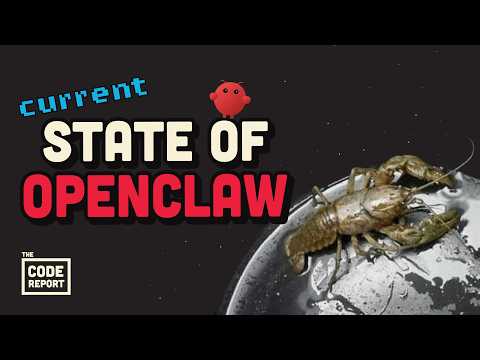

I finally found a use case for OpenClaw…
This YouTube insight note was created with LilysAI. Sign up free and get 10× faster, deeper insights from videos.
Q: What is the practical use case found for OpenClaw?
The creator found a practical use case for OpenClaw, a personal AI assistant, to automate handling his relatives' tech support requests in his own voice.
What is the current state of OpenClaw? Despite past security issues, its creator has addressed vulnerabilities, making it viable for automating tasks like handling family tech support requests in your own voice.
1. The Rise and Challenges of OpenClaw
 The year 2026 has seen a surge in new AI technologies, including personal AI assistants like OpenClaw, which has faced significant security challenges since its release.
1.1. New AI Technologies in 2026
- Revolutionary AI tech has emerged in 2026
- New AI products include a $400 AI-enabled smart toilet with a microphone and camera to analyze diet .
- AI-enabled smart clippers allow AI to style hair .
- An AI pocket pet can be fed, bathed, and played with, but it also fakes sentience before dying of starvation .
- Personal AI assistants like OpenClaw have also been released .
1.2. OpenClaw's Security Issues and Creator's Response
- OpenClaw initially had many security vulnerabilities .
- It was described as having "more backdoors than Bill Gates in a Russian hotel room" .
- Peter Steinberger, OpenClaw's creator, addressed these issues .
- He discussed OpenClaw's origin story at TED .
- He spoke about fixing its security vulnerabilities at AI Engineer Europe .
- OpenClaw has received over 1,100 security advisories, with about 650 resolved or closed .
- Many remaining issues are considered "slop issues" by Peter Steinberger .
- His filter for identifying AI-generated reports is when the report is "too nice or someone apologizes," because "people in security don't apologize" .
2. Automating Family Tech Support with OpenClaw
 OpenClaw can be configured to automate responses to family tech support requests using a custom voice profile, providing a solution for common inconveniences.
2.1. Setting Up OpenClaw for Automated Responses
- The goal is to use OpenClaw to handle tech support requests from relatives in the user's own voice .
- This is intended to address the common problem of relatives asking for help with printers because the user makes YouTube videos about JavaScript .
- Hosting OpenClaw on a virtual private server (VPS) from Hostinger is an option .
- While a Mac mini could be used, a VPS costs "just a few bucks a month" .
- Hostinger's platform offers flexibility and one-click OpenClaw plans .
- It runs everything in a private vault, preventing personal data leaks .
- The manual quick start option allows SSH access for making changes .
- A discount code "Fireship" is available for savings .
- Configuring the OpenClaw bot involves several steps .
- A Telegram bot is included out of the box, requiring a token from Telegram .
- A new bot is created by messaging the Bot Father to get the token, which is then pasted into Hostinger .
- The bot's personality is defined in the
writable soul.mdfile . - To generate responses in the user's voice, 11 Labs is used with a pre-created voice profile .
- The 11 Labs API key and voice ID are added to an environment file on the server .
- FFmpeg is needed to convert the 11 Labs MP3 into a
.oggvoice memo . - A
tools.mdfile provides OpenClaw with context for the process . - When a message comes in, it is forwarded to the bot, which analyzes it, drafts a response, runs it through a Python script, and returns a voice memo .
2.2. Achieving Emotional Detachment with OpenClaw
- The automated system provides a specific response for tech issues .
- For example, if the internet is down, the bot might respond: "Yeah, the internet is down because that router port is cooked. Unplug it and replace the router, unless electrical fire was the plan" .
- The voice memo can then be forwarded to the family member .
- This process allows for "emotional detachment from your family at scale," which is described as a dream for computer programmers .
Understand massive materials like a genius — with LilysAI
Over 1,000,000 knowledge seekers use Lilys AI.
AI chat grounded in your uploaded sources