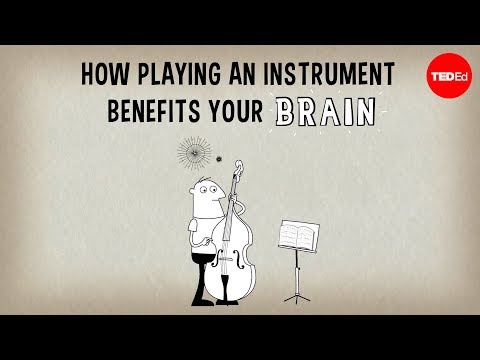

How playing an instrument benefits your brain - Anita Collins
This YouTube insight note was created with LilysAI. Sign up free and get 10× faster, deeper insights from videos.
Playing a musical instrument activates all areas of the brain simultaneously, enhancing cognitive functions like memory and problem-solving. This intense mental workout strengthens the corpus callosum, improving communication between brain hemispheres and leading to more efficient, creative thinking.
1. Playing an Instrument Lights Up the Brain
 Playing a musical instrument is like a full-body workout for the brain, activating all areas at once and enhancing cognitive functions.
1.1. Observing Brain Activity
- Scientists can now observe the brain in real-time using tools like FMRi and PET scanners.
- Listening to music activates multiple brain areas simultaneously .
- These areas light up to process different elements of music, like melody and rhythm, before integrating them into a complete experience .
- This happens incredibly quickly, within the time it takes to tap your foot to a beat .
- Playing a musical instrument causes even more widespread brain activity .
- When musicians play, their brains show a "fireworks" display, with many areas lighting up and processing complex information rapidly and interactively .
1.2. The Brain Benefits of Playing Music
- Playing an instrument engages all areas of the brain at once .
- This is particularly true for the visual, auditory, and motor cortices .
- Structured practice strengthens brain function .
- Similar to other activities, the rigorous and organized practice involved in playing music enhances brain function .
- This enhanced function can then be applied to other tasks .
- Playing music requires complex coordination and processing .
- It demands fine motor skills controlled by both the left and right hemispheres of the brain .
- It also requires linguistic and mathematical precision, which engages the left hemisphere more, and creativity, typically associated with the right hemisphere .
- This intense activity strengthens the corpus callosum .
- The corpus callosum is like a bridge connecting the left and right hemispheres of the brain .
- A stronger corpus callosum allows messages to travel faster and through more pathways, leading to more efficient and creative problem-solving in school and life .
- Musicians develop advanced executive functions .
- Because playing music involves creating and understanding emotional content, musicians develop high-level skills in managing interconnected tasks .
- These skills include planning, strategizing, and analyzing both cognitive and emotional aspects simultaneously .
- These abilities positively impact memory systems .
- Musicians demonstrate superior memory recall, creation, and storage capabilities .
- They use their highly connected brains to attach multiple conceptual, emotional, auditory, and contextual labels to memories, making them easily retrievable like an advanced internet search engine .
1.3. Music's Unique Impact
- Research suggests music's benefits are distinct from other arts .
- Studies have shown that learning to play a musical instrument has unique effects compared to other activities, including other arts .
- Learning music leads to measurable brain development .
- In studies where participants with similar initial cognitive abilities were randomly assigned to learn music or other activities, those who learned music showed improvements in multiple brain areas .
- Music enriches our understanding of the brain .
- Recent research on the mental benefits of playing music deepens our understanding of brain function and the complex interactions that make up the "orchestra" of the human brain .
Understand massive materials like a genius — with LilysAI
Over 1,000,000 knowledge seekers use Lilys AI.
AI chat grounded in your uploaded sources